

In today's digital wave sweeping across industries, identity verification—as a fundamental link in social governance and commercial services—is undergoing a critical innovation shift from fixed counter operations to mobile and intelligent solutions. The PDA identity verification handheld terminal, with its integrated design, industrial-grade performance, and multi-scenario adaptability, has become core equipment for building trusted identity authentication systems in government, finance, transportation, and other fields. This article delves into the technical implementation pathways and application value of this device in human-ID verification scenarios.
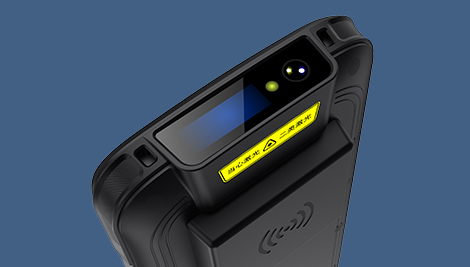
1. Technical Architecture: Multi-modal Fusion for Precision Verification
The PDA identity verification handheld terminal establishes a triple verification mechanism of "document reading + biometric feature capture + data comparison" through hardware modular design and software algorithm optimization. Taking a domestic device as an example, its core configurations include:
Document Recognition Module: Integrates a Ministry of Public Security-certified second-generation ID reader using 13.56MHz RF technology, capable of decrypting chip information within 0.3 seconds and supporting machine-readable/visual-readable dual-mode switching. Paired with an OCR engine, it can perform image recognition on over 20 types of documents like passports and driver's licenses, with text extraction accuracy reaching 99.9%.
Biometric Feature Collection System: Features a front-facing 5-megapixel camera with liveness detection and a rear-facing 13-megapixel camera with autofocus for capturing high-definition facial images. The fingerprint module employs an FAP10-grade optical sensor with anti-spoofing capabilities, matching precision compliant with GA/T 1012-2012 standards.
Data Comparison Engine: Equipped with an edge computing chip that supports offline facial feature extraction and fingerprint template matching. Real-time 4G/5G network connectivity to the Ministry of Public Security's population database enables a closed-loop "front-end collection to cloud verification" process.
This multi-technology fusion design allows a single device to complete the entire workflow—from document authenticity verification to biometric capture and identity validation—compressing traditional 10-minute manual verification processes to under 45 seconds.
2. Scenario Adaptation: Industry-Wide Identity Verification Solutions
(1) Mobile Government Services
In grassroots policing scenarios, smart terminals issued by a provincial public security department enable "one-device multi-function": Officers can handle 12 tasks during community visits, including resident registration, key personnel checks, and rental management. The built-in NFC module supports reading electronic residence permits, and with GPS functionality, it automatically generates geographically tagged verification records, increasing mobile population management efficiency by 300%.
(2) Real-Time Financial Risk Control
A commercial bank's deployment in mobile operations reduced account opening time from 45 minutes to 8 minutes. Staff simultaneously perform ID verification, facial matching, and bank card binding via the device, with all data encrypted and transmitted to risk control systems in real-time. This solution lowered the bank's new account fraud rate by 82% and boosted customer satisfaction to 99.9%.
(3) Intelligent Transportation Management
At a high-speed rail station security checkpoint, a branded terminal achieves "human-ID-ticket" three-in-one verification: Scanning an ID automatically retrieves ticket purchase information while performing facial comparison, all within 3 seconds. During peak travel seasons, a single device handles up to 1,200 verifications daily with a false recognition rate below 0.01%.
3. User Experience: Industrial Design Empowering Efficient Operations
(1) Human-Machine Interaction Optimization
The device uses a 5.5-inch Corning Gorilla Glass screen supporting wet-hand and gloved touch, with auto-brightness adjustment up to 800 nits in strong light. A combination of physical scan keys and virtual buttons increases barcode scanning success rates to 99.9%, improving efficiency by 40% over touch-only solutions.
(2) Battery Life and Reliability
A model with a 5,000mAh removable battery supports fast charging and offers 10 hours of continuous operation. It passes 1.5-meter drop tests and IP65 certification, functioning stably in environments from -20°C to 60°C, suitable for dusty logistics centers or freezing border checkpoints.
(3) Data Security System
Data storage is encrypted using the SM4 national cryptographic algorithm, with support for two-factor authentication and remote data wiping. After deployment in a government system, it intercepted 17 counterfeit document attacks without any sensitive data leaks.
4. Future Trends: Evolution from Tool to Platform
As digital identity authentication systems mature, PDA terminals are evolving into "mobile identity service platforms":
Multi-modal Biometric Recognition: Integrating voiceprint and palm vein recognition for a quadruple biometric verification system.
Blockchain Record-keeping: Verification logs are recorded on-chain in real-time to ensure data immutability.
AI-Assisted Decision-making: Edge computing enables risk warnings, such as identifying abnormal behavior patterns.
Seamless Access Integration: Linking with access control systems for "face + ID + code" three-in-one passage.
A pilot project showed that terminals with AI algorithms increased suspicious person recognition accuracy to 99.9%, a 27-percentage-point improvement over traditional methods. This evolution is reshaping workflows in public safety, financial services, and smart cities.
5. Industry Value: Quantitative Analysis of Cost Reduction and Efficiency Gains
At a government service center, deploying 200 terminals yielded:
Labor Costs: Reduced staff by 40%, saving ¥12 million annually.
Process Efficiency: Shortened average handling time by 65%, increasing daily capacity 2.3-fold.
Risk Control: Impersonation cases dropped 92%, preventing over ¥30 million in annual losses.
These metrics highlight the terminal’s value in enhancing service efficiency and mitigating operational risks. When device costs account for less than 15% of project investment, the resulting process optimization and risk control benefits far exceed initial expenditures.
In the deep waters of digital transformation, the PDA identity verification handheld terminal has transcended its role as a simple data collection tool to become vital infrastructure for building social credit systems. With deeper integration of 5G, AI, and blockchain technologies, it will redefine the efficiency and security boundaries of identity verification, providing stronger technical support for social governance in the digital economy era.