

In today's industrial landscape, efficiency and accuracy are fundamental competitive differentiators. RFID scanning handheld industrial tablets – intelligent terminals integrating mobile computing, data capture, and wireless communication – are reshaping operations across manufacturing, logistics, warehousing, and retail. This guide explores how these devices address critical operational challenges and how to select the right solution for your business needs.
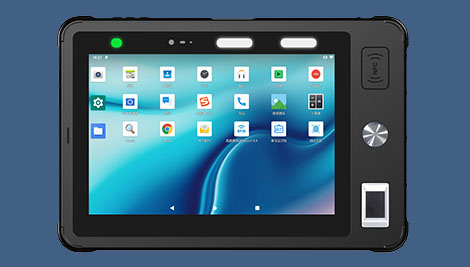
1. Core Advantages: Merging RFID Technology with Industrial Tablets
RFID (Radio Frequency Identification) enables automatic, non-contact identification and data capture via radio waves. Compared to traditional barcode scanning, RFID offers distinct advantages: no line-of-sight requirement, batch reading capability, larger data capacity, and superior resistance to contamination. When integrated into robust industrial-grade handheld tablets, a powerful synergistic effect emerges.
RFID industrial tablets combine high-performance computing, ruggedized design, long-lasting batteries, and integrated RFID modules into a complete mobile data capture solution. Engineered for harsh environments, they withstand drops, vibration, dust, moisture, and extreme temperatures while delivering reliable RFID scanning.
2. Industry Applications & Solving Core Pain Points
Manufacturing Process Optimization:
Track raw materials, work-in-progress (WIP), and finished goods in real-time. Deploying RFID read points at workstations provides accurate production visibility, enabling managers to identify bottlenecks instantly. One leading auto parts manufacturer reduced data collection time by 70% and errors to near zero, achieving true lean manufacturing.
Warehouse & Logistics Efficiency Revolution:
Replace error-prone manual logging and slow barcode scanning. RFID tablets enable instant pallet-level inventory counts, dramatically speeding up receiving, putaway, picking, and shipping. In cold chain logistics, scan cargo through closed refrigerator doors – maintaining temperature integrity while boosting productivity.
Equipment Asset Management & Maintenance:
Create complete lifecycle records for high-value assets. Link maintenance histories and part replacements via RFID tags, establishing a fully traceable management chain. This predictive maintenance approach minimizes unplanned downtime and extends equipment lifespan.
3. Key Selection Criteria for RFID Scanning Industrial Tablets
Navigate the crowded market by prioritizing these critical factors:
RFID Performance Specifications:
Read Range: Choose based on application (e.g., 0-1m for assembly, up to 15m for warehousing).
Multi-Tag Handling: Ensure advanced anti-collision algorithms for accurate reads in dense tag environments.
Frequency Compatibility: Match LF (Low Frequency), HF (High Frequency), or UHF (Ultra-High Frequency) to your specific operational needs.
Industrial Durability Standards:
Ingress Protection: IP65/IP67 rating for dust and water resistance.
Ruggedness Certification: MIL-STD-810G compliance for shock/vibration tolerance.
Operating Temperature: Wide range (e.g., -20°C to 60°C / -4°F to 140°F) for extreme environments.
Display Visibility: High-brightness screen for readability in direct sunlight.
System Performance & Expandability:
Processing Power: Multi-core processor & ample RAM for smooth multitasking.
OS Choice: Android for flexibility/ease-of-use; Windows for enterprise compatibility.
I/O Ports: Essential interfaces (USB, serial, PSAM, dedicated scanner trigger).
Battery Life & Charging:
Capacity: High-capacity battery supporting 10+ hours of continuous operation.
Charging Solutions: Fast-charge technology and hot-swappable options.
4. Critical Success Factors for RFID System Implementation
Deploying RFID tablets is just the first step. Maximize ROI by focusing on:
Business Process Re-engineering: Redesign workflows to leverage RFID's core strengths (batch reads, distance scanning), don't just replace barcodes.
Data Integration & Visualization: Ensure seamless connectivity with ERP, WMS, MES systems. Utilize BI tools for actionable dashboards and real-time decision-making.
Staff Training & Change Management: Address potential resistance through comprehensive training and incentives. Emphasize how RFID reduces workload, not increases it.
Continuous Optimization: Regularly assess system performance, gather user feedback, and refine deployment. Stay updated with evolving technology.
5. Future Trends & Technological Evolution
RFID industrial tablets are evolving towards greater intelligence and integration:
AI at the Edge: On-device AI for real-time item classification and anomaly detection.
5G & IoT Integration: Ultra-low latency for seamless cloud collaboration.
AR Visual Assistance: Overlaying digital instructions via Augmented Reality for complex tasks.
Blockchain Traceability: Immutable product lifecycle records.
Sustainable Design: Eco-friendly materials and recyclability reducing e-waste impact.
Conclusion
RFID scanning handheld industrial tablets represent more than a tool upgrade; they are a strategic pillar in digital transformation. They solve the inherent inefficiencies, high error rates, and latency issues of traditional data capture, providing a robust foundation for smart manufacturing and intelligent logistics. Success lies in selecting the right hardware based on core needs, prioritizing seamless system integration, and fully leveraging the technology's potential to gain a competitive edge.
As Industry 4.0 accelerates, the convergence of RFID and mobile computing will unlock unprecedented innovation. Businesses that proactively implement and optimize RFID solutions will secure significant operational advantages and achieve transformative efficiency gains.