

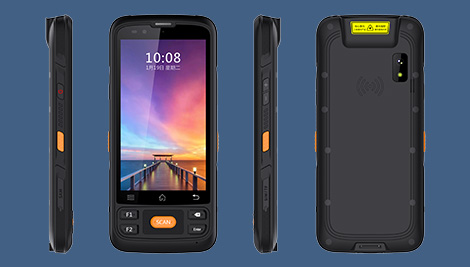
In the wave of refined management in the pharmaceutical supply chain, RFID handheld high-frequency terminals are becoming a core technological support in the logistics sorting links of pharmacy chain warehouses, thanks to their precise identification, efficient operation, and real-time synchronization capabilities. This article focuses on the innovative application of 13.56MHz high-frequency RFID technology in drug storage scenarios, constructing an intelligent management system covering the entire process from inbound to outbound through deep integration of technical characteristics and practical needs.
1. Technical Characteristics of High-Frequency RFID and Their Compatibility with Drug Warehousing
High-frequency RFID systems, centered on 13.56MHz radio frequency signals, enable non-contact data interaction within the 3-30MHz frequency band. Their technical characteristics align closely with the requirements of drug warehousing. This frequency band offers meter-level positioning accuracy, allowing rapid batch reading of tags within a 1-3 meter range. A single scan can identify dozens of tags simultaneously, increasing efficiency by 5-10 times compared to traditional barcode scanning. In drug sorting scenarios, this "batch reading" feature breaks through the efficiency bottlenecks of traditional piece-by-piece scanning, especially suitable for rapid inventory checks of high-density shelves and entire boxes of drugs.
In terms of technical security, high-frequency RFID adopts a dual-protocol architecture of ISO14443/15693, supporting encrypted data transmission and anti-collision algorithms to ensure the security of sensitive information such as drug batch numbers and expiration dates. Its anti-metal interference design can penetrate non-metallic packaging materials, maintaining stable identification performance even when drug boxes are stacked or placed on metal shelves. In cold chain drug storage scenarios, industrial-grade handheld terminals offer a wide temperature operating range of -20°C to 60°C and an IP65 dust and water resistance rating, adapting to special environments like cold storage and constant temperature warehouses.
2. Practical Path to Full-Process Intelligent Management
In the inbound management stage, RFID handheld terminals interact in real-time with the WMS via wireless networks, automating the entire "inspection-recording-shelving" process. Operators scan RFID tags on drug packaging boxes, and the system automatically compares purchase order information, verifies key parameters such as batch numbers, production dates, and expiration dates, and simultaneously updates inventory data. Compared to traditional manual entry, this process reduces labor input by 30%, decreases error rates from 3%-5% to below 0.001%, ensuring precise control of "book-to-physical" consistency.
During in-warehouse management, the positioning and tracking capabilities of high-frequency RFID play a key role. By deploying positioning tags on shelves, the system can track drug storage locations in real-time, supporting a "one-click navigation" shelf positioning function. When a specific batch of drugs needs allocation, the terminal quickly locates the target shelf coordinates, generating the shortest picking path combined with route optimization algorithms, reducing ineffective walking distance for operators by over 30%. In inventory counting scenarios, handheld terminals support a "dynamic counting" mode, allowing operators to scan while walking, with the system automatically summarizing counting data and generating profit/loss reports. Traditional full-warehouse counting that required 1-2 days is compressed to 2-3 hours.
The outbound sorting stage is the core scenario where RFID technology demonstrates its value. Through deep integration with intelligent sorting systems, handheld terminals automatically compare outbound order information when scanning drug tags. If discrepancies in batch numbers, quantities, or approaching expiration dates are detected, the system immediately triggers an alarm mechanism, preventing errors in dispatch and omissions at the source. In multi-order parallel processing scenarios, the system can automatically plan optimal sorting paths, prioritizing the allocation of near-expiry drugs according to the "first-in, first-out" principle, avoiding inventory backlog and expiration losses.
3. Dual Value of Quality Traceability and Cost Optimization
In terms of quality traceability, each drug item is equipped with a unique RFID tag that records full-chain information from production to sale. As drugs move within the warehouse or are shipped out, readers automatically capture and update dynamic data such as location and timestamps, forming an immutable electronic traceability chain. This full-lifecycle management not only meets GSP regulatory requirements for drug circulation but also enables rapid localization of problematic batches, achieving precise recalls within 48 hours.
From a cost-benefit perspective, the large-scale application of RFID handheld terminals brings significant cost reduction and efficiency gains. In labor costs, the same workload can reduce operational staff by 30%-50%; in error correction costs, losses due to shipping errors leading to returns and exchanges are reduced—industry statistics show that traditional warehouses incur losses of 1%-3% of total revenue due to shipping errors; in tag costs, although the unit price of RFID tags is higher than barcodes, they can be reused tens of thousands of times, resulting in lower long-term comprehensive costs. At the inventory management level, real-time inventory data synchronization increases inventory turnover rates by 15%-20%, and dynamic replenishment strategies reduce inventory holding costs by over 10%.
4. Future Trends and Industry Outlook
With the continuous evolution of IoT technology, RFID handheld terminals are developing towards greater intelligence and integration. The adoption of 5G networks will enable millisecond-level data synchronization, supporting larger-scale concurrent tag reading; the integration of AI algorithms equips the system with predictive analysis capabilities, allowing it to forecast inventory shortage risks in advance and automatically trigger replenishment processes; the combination with blockchain technology further enhances data immutability, building a transparent and trustworthy chain from production to consumption.
Against the backdrop of increasing concentration in the pharmaceutical industry, RFID handheld high-frequency terminals have become key infrastructure for pharmacy chain enterprises to build core competitiveness. Through technological innovation and process reengineering, this technology not only addresses pain points in traditional warehouse management such as low efficiency, high error rates, and cumbersome processes but also promotes the transformation and upgrading of drug circulation towards "efficiency, intelligence, and refinement," providing a solid technical guarantee for patient medication safety and transparent supply chain management.