

Amid the wave of refined operations in the healthcare industry, store inventory management is rapidly transitioning from traditional methods to digitalization and intelligence. As hubs connecting medical supplies and end-user demand, scenarios such as clinics, pharmacies, and medical device stores rely on efficient inventory management to directly impact service quality and operational costs. The adoption of medical handheld PDA scanner technology has introduced innovation to this field. This article delves into how PDA scanning empowers medical store inventory management—building an efficient, secure, and traceable operational system—from three dimensions: technical advantages, application scenarios, and implementation strategies.
1. Core Challenges in Medical Store Inventory Management and PDA’s Technological Solutions
Traditional medical store inventory management faces three persistent issues:
Data Latency: Manual entry of inventory data often leads to delays, causing misalignment between procurement decisions and actual demand.
Operational Errors: Reliance on manual verification of critical information (e.g., drug batch numbers, expiration dates) increases risks of inaccuracies and omissions.
Traceability Gaps: Paper-based records hinder rapid identification of problematic batches, escalating compliance risks and patient safety concerns.
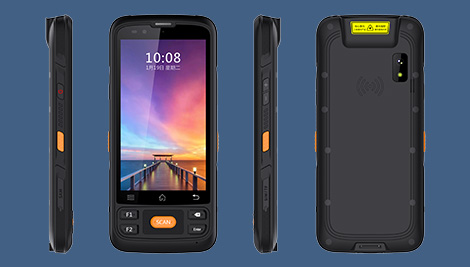
Medical-grade PDA scanning devices address these challenges through seamless hardware-software integration:
High-Accuracy Data Capture: Equipped with professional-grade scanning engines, PDAs swiftly read 1D/2D barcodes and RFID tags, even on damaged or crumpled packaging.
Real-Time Synchronization: Via WiFi or 4G/5G networks, inventory changes are instantly uploaded to management systems, ensuring synchronization of accounts and physical assets (book-to-physical consistency).
Multi-Scenario Adaptability: Offline mode caches data, with automatic synchronization upon network recovery, suitable for complex environments like pharmacies, warehouses, and treatment rooms.
2. Six Application Scenarios of Handheld PDA Scanners in Medical Inventory Management
1.Smart Receiving & Inspection
Upon drug or device delivery, warehouse staff use PDAs to scan supplier delivery slips. The system automatically cross-references purchase order data, while scanning product barcodes verifies batch numbers, manufacturing dates, and expiration dates. Alerts trigger for anomalies (e.g., near-expiry, batch mismatches), preventing erroneous warehouse entry.
2.Precision Picking & Dispensing
Adhering to the “FEFO” (First-Expired-First-Out) principle, PDAs intelligently plan picking routes based on expiration dates and batches. For instance, when dispensing medications, scanning a patient’s prescription barcode prompts the system to match stock locations and suggest optimal routes, avoiding human errors in selection.
3.Dynamic Stock Counting
Unlike traditional counts that require halting operations, PDAs enable “in-stock counting”: staff scan items while verifying quantities, with real-time calculation of surpluses/shortages. Zone or batch-based counting boosts efficiency—one chain pharmacy reported a 60% faster count and error rates below 0.01%.
4.Automated Expiration Alerts
By scanning product barcodes, PDAs retrieve expiration data from systems and trigger tiered warnings (e.g., 90 days pre-expiry). This allows prioritized handling of near-expiry goods, reducing write-off rates.
5.End-to-End Traceability
From procurement to patient use, PDAs log operational logs at each step. If a drug batch exhibits quality issues, scanning its barcode rapidly traces its flow, enabling precise recalls and meeting GSP (Good Supply Practice) regulations.
6.Mobile Replenishment Decisions
Integrating sales data and inventory thresholds, PDAs generate dynamic replenishment suggestions. For example, when supplies dip below safety stock, the system pushes alerts with supplier details, supporting on-the-spot ordering.
3. Five Critical Factors for PDA Scanning System Implementation
1.Device Selection: Catering to Medical Scenarios
Protection Rating: IP65 or higher for dust/water resistance in humid pharmacy environments.
Battery Life: Sustains 8+ hours of continuous use with fast charging.
Screen Readability: Displays remain clear under strong light for outdoor delivery scenarios.
2.System Integration: Breaking Data Silos
PDAs must seamlessly interface with ERP, WMS, HIS, etc., enabling bidirectional data flow. For example, scanning a patient’s wristband barcode auto-links prescription data and deducts pharmacy stock.
3.Operator Training: From "Usage" to "Mastery"
Develop SOPs (e.g., “scan product barcode before location code”).
Implement simulation training modules to enhance proficiency in virtual inventory scenarios.
4.Process Optimization: Reducing Burden
Avoid digitization for its own sake; streamline existing workflows—e.g., eliminate redundant manual logs by treating PDA data as the single source of truth.
5.Data Security: Safeguarding Medical Information
Enable encrypted data transmission to prevent patient data leaks.
Implement tiered access controls to minimize operational errors.
4. Case Study: Transformation of a Regional Chain Pharmacy
A chain pharmacy in Eastern China achieved the following after deploying PDA scanners:
Inventory Accuracy: Rose from 82% to 99.99%.
Counting Cycle: Reduced from monthly full counts to weekly dynamic counts.
Write-Off Rate: decreased by 78% due to improved expiration management.
Patient Satisfaction: increased by 65% due to reduced stockout complaints.
5. Future Outlook: PDA Integration with Medical IoT
With 5G and IoT advancements, PDAs will evolve from standalone devices into nodes within medical supply networks:
Smart Alerts: Sensors monitor temperature/humidity, triggering PDA notifications for anomalies.
Unmanned Operations: Integrate with smart cabinets for 24/7 self-service medication pickup.
Big Data Analytics: Leverage scan data to optimize procurement strategies and predict regional drug demand.
Conclusion
As medical store inventory management shifts from “experience-driven” to “data-driven,” handheld PDA scanners—with their precision, efficiency, and traceability—have become core tools for restructuring operational workflows. For healthcare institutions, adopting tailored PDA solutions alongside scientific management systems is not only essential for cost reduction and efficiency gains but also a strategic move to ensure medical safety and service quality. As technology boundaries expand, PDAs will unlock even greater value across the entire lifecycle of medical supply management.