

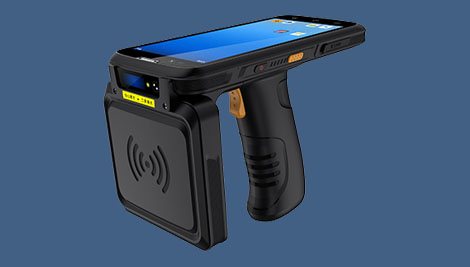
Today, with the accelerated integration of global supply chains, the demand for inventory management efficiency and accuracy among export-oriented enterprises is increasingly rising. As a key node connecting the physical world and digital systems, the export edition handheld terminal UHF RFID device, with its unique batch reading capability and mobile operation features, is becoming a core tool for WMS systems to achieve automatic recording of inbound and outbound processes. This article will deeply analyze the innovative practices of this device in inventory management from three dimensions: technical principles, application scenarios, and implementation value.
Technical Characteristics: Natural Adaptability of UHF RFID
UHF RFID (860-960MHz) technology has three core advantages: strong penetration, long recognition distance, and simultaneous reading of multiple tags. Compared to the traditional barcode scanning mode that requires aligning each item, UHF RFID handheld terminals can instantly read hundreds of tags within a 3-25 meter range. This non-contact batch collection capability perfectly matches the rapid inbound and outbound needs of boxed and palletized goods in warehouses. The device's built-in anti-metal interference algorithm and multi-path recognition technology further ensure stable reading performance in complex warehouse environments.
Deep Coordination Mechanism with WMS Systems
In the WMS system architecture, the handheld terminal plays a dual role as a "mobile data collector" and "on-site operation commander." Through wireless communication modules like Bluetooth/Wi-Fi/4G, the device can interact with the WMS server in real-time. When operators execute outbound instructions, the system automatically pushes the target storage location list to the terminal; the operator only needs to scan the location label to initiate batch reading mode. The RFID tag data collected by the device is compared in real-time with the inventory records preset in the WMS system, automatically verifying key information such as goods quantity, batch, and expiration date. Any anomalies immediately trigger audible and visual alarms, eliminating manual entry errors at the source.
Analysis of Fully Automated Operation Scenarios
In the inbound process, the UHF RFID handheld terminal supports full-process automation from "arrival pre-inspection - batch verification - storage location allocation - system update." When goods arrive at the dock, the device can quickly verify the label integrity of entire pallets, automatically identifying missing or duplicate labels. By linking with the WMS system's dynamic location allocation algorithm, the device can recommend optimal storage locations in real-time and synchronously update the system inventory map. In the outbound process, the system supports an intelligent operation mode of "order wave aggregation - optimal path planning - picking path navigation - batch verification outbound." Through heatmaps, it guides operators along the optimal path to complete parallel picking for multiple orders, achieving millisecond-level synchronization of outbound data through batch reading.
Value Creation: From Efficiency Improvement to Management Evolution
The value brought by this technological combination goes far beyond operational efficiency improvement. With real-time inventory flow data collected by the export edition handheld terminal UHF RFID device, the WMS system can build a multi-dimensional inventory health analysis model, automatically identifying stagnant inventory, predicting replenishment needs, and optimizing inventory turnover. The built-in operation time statistics module can accurately calculate the labor cost per operation unit, providing data support for warehouse personnel performance management. A deeper impact lies in the innovation of management models—shifting from the traditional "human-driven system" to a "system-driven human" approach. Through the automated push of system instructions and real-time feedback of operation data, closed-loop control and continuous optimization of inventory management are achieved.
Implementation Path and Pitfall Avoidance Guide
Successfully implementing this solution requires following a three-step strategy: "top-level design - pilot verification - full promotion." In the project initiation phase, key technical verifications such as RFID tag type testing, reader power calibration, and anti-interference solution validation need to be completed. The pilot phase should select typical business scenarios for small-scale verification, focusing on core indicators like system response speed, data synchronization accuracy, and exception handling mechanisms. The full promotion phase requires a complete personnel training system and operation maintenance mechanism to ensure that on-site operators are proficient in device operation and exception handling methods.
Future Outlook: Evolution Direction of Smart Warehousing
With the continuous evolution of IoT technology, UHF RFID handheld terminals are developing towards smarter and more integrated directions. Future devices will integrate more sensor modules to achieve real-time collection of status parameters such as temperature, humidity, and vibration of goods. Through deep collaboration with automated equipment like AGVs and shuttle vehicles, a "human-machine-material" tripartite collaborative smart warehousing ecosystem can be built. In terms of data value mining, intelligent prediction algorithms based on big data from inventory flows will further enhance the foresight and precision of inventory management.
Standing at the forefront of the digital transformation wave in supply chains, the deep integration of the export edition handheld terminal UHF RFID device with WMS systems not only represents a breakthrough improvement in inventory management efficiency but also heralds a paradigm shift in supply chain management from "experience-driven" to "data-driven." This transformation is reshaping the competitive landscape of global supply chains, building a digital moat that is difficult to replicate for export-oriented enterprises.