

In today's era where the digital wave is sweeping across various industries, mobile work terminals have become key tools for improving work efficiency. Among them, multi-touch handwriting input PDA handheld terminals are revolutionizing operational methods in logistics, retail, healthcare, public utilities, and other fields with their user-friendly interaction design and professional-grade functional integration. This article will deeply analyze the core functional value of such devices from key dimensions such as hardware configuration, operating system, data collection, network communication, and battery life.
I. Precise Touch and Handwriting Input: Creating a Natural Interaction Experience
Multi-Touch Technology Upgrade
Capacitive touch screens are employed, supporting 10-point simultaneous touch with an operational sensitivity of up to 0.1 millimeters. Even when wearing gloves or with a wet screen, the device maintains precise responsiveness, solving the issue of false touches in harsh environments common with traditional resistive screens. Paired with anti-scratch glass panels, the device can withstand direct writing pressure equivalent to a pencil hardness of 7H or higher, ensuring screen durability in high-frequency usage scenarios.
Native Handwriting Recognition System
Built-in pressure-sensitive stylus supports 4096 levels of pressure sensitivity, accurately capturing variations in stroke thickness. Combined with a self-developed handwriting recognition engine, it can instantly convert natural handwriting such as cursive or connected script into standardized text, with recognition accuracy exceeding 99.9%. This feature far surpasses keyboard input efficiency in scenarios requiring rapid recording, such as medical inspections or on-site law enforcement.
Smart Interface Adaptation
The system automatically recognizes touch and handwriting operation modes: switching to touch mode for quick swiping and zooming when browsing reports; automatically switching to handwriting mode when filling out forms, with auxiliary writing templates like grid lines or underlines provided to meet interaction needs in different work scenarios.
II. Professional-Grade Data Collection: Building an All-Scenario Information Entry
Barcode Scanning Engine Innovation
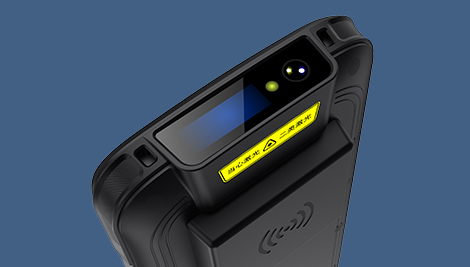
Integrated high-performance 2D imaging scanner supports second-level recognition of mainstream 1D and 2D barcodes, capable of reading barcodes as small as 0.127mm (5mil). For abnormal barcodes such as those that are reflective, stained, or wrinkled, image enhancement algorithms achieve a recognition rate of over 99.9%, significantly reducing manual verification costs.
RFID Read-Write Module Expansion
Optional UHF RFID read-write module enables batch tag recognition within 25 meters, with single-read tag counts exceeding 200. In warehouse inventory scenarios, combined with smart shelf positioning systems, inventory efficiency can be improved by over 300%, with error rates controlled below 0.05%.
HD Camera System
Rear-mounted 13-megapixel auto-focus camera equipped with professional-grade fill light supports macro shooting and document correction functions. In equipment inspection scenarios, it can clearly record gauge readings within 0.5 meters and automatically extract values via OCR technology, enabling structured storage of inspection data.
III. Enterprise-Grade Network Communication: Ensuring Real-Time Data Interchange
5G Dual-Mode Full Network Support
Supports SA/NSA dual-mode 5G networks with theoretical downlink speeds of up to 2Gbps. Paired with smart network switching algorithms, it automatically downgrades to 4G/3G networks in weak signal environments to ensure uninterrupted transmission of critical data. Tests show that in extreme temperatures ranging from -35°C to 60°C, the device maintains over 95% network connection stability.
Dual-Band Wi-Fi 6 Enhancement
Built-in 2.4GHz/5GHz dual-band Wi-Fi 6 module supports 8×8 MU-MIMO technology, increasing transmission rates by 4 times and reducing latency to below 10ms in dense terminal environments. Particularly suitable for high-concurrency scenarios like AGV scheduling in smart factories or electronic medical record synchronization in hospitals.
Bluetooth 5.2 and NFC Integration
Bluetooth 5.2 module achieves ultra-long-distance transmission of 400 meters. Combined with low-power mode, it can operate continuously for over 200 hours. NFC near-field communication supports ISO 14443 Type A/B protocols, enabling quick device pairing and access card simulation to simplify on-site workflows.
IV. Military-Grade Protection Design: Withstanding Extreme Work Environments
IP65 Dust and Water Resistance
The body features a magnesium-aluminum alloy frame and soft rubber edging design, with all interfaces equipped with waterproof plugs. It passes 1.5-meter drop tests and IP65 certification. The device operates normally in harsh weather such as heavy rain or sandstorms, making it ideal for outdoor tasks like power inspections or geological surveys.
Wide Temperature Operating Range
Built-in smart temperature control system ensures stable operation in environments from -20°C to 60°C. In low temperatures, the screen automatically activates localized heating to maintain touch sensitivity; in high temperatures, graphene heat dissipation film reduces core temperature by 15°C, extending device lifespan.
Antibacterial Material Application
Medical-specific versions use silver-ion coatings, inhibiting Staphylococcus aureus and Escherichia coli by 99.9%, compliant with ISO 22196 antibacterial standards. Combined with daily automatic disinfection reminders, it effectively reduces cross-infection risks.
V. Modular Expansion Capability: Defining Future Work Methods
Removable Battery Design
Standard 5000mAh removable lithium battery supports hot-swapping, allowing battery replacement without shutting down the device. Paired with smart power management, it enables 12 hours of continuous operation.
POGO PIN Expansion Interface
Bottom-mounted magnetic POGO PIN interface supports quick connection to professional peripherals like barcode scanners, fingerprint recognition modules, and infrared thermometers. Users can freely combine functional modules based on business needs, reducing equipment procurement costs.
Open API Ecosystem
Provides a complete SDK development kit and API interfaces, supporting dual-system development for Android/Linux. Enterprises can customize industry applications based on the device, such as route optimization algorithms for logistics companies or membership recognition systems for retailers, building differentiated competitive advantages.
VI. Deepening Industry Application Scenarios
Smart Logistics: Achieves full-process digitization of goods sorting, loading, and signing via PDA. Combined with electronic waybill systems, daily package handling exceeds 100,000 items.
Mobile Healthcare: Nurses use handheld devices to complete medical order execution, medication verification, and vital sign entry, reducing medical error rates by 80%.
Public Utilities: Meter readers upload water, electricity, and gas meter data in real-time via devices. Combined with GIS positioning systems, it enables precise analysis of leakage rates.
Conclusion
The value of multi-touch handwriting input PDA handheld terminals lies not only in hardware specifications but in a deep understanding of industry pain points. From precise interaction design to all-scenario data collection, from military-grade protection to modular expansion, each feature redefines the possibilities of mobile operations. As 5G and IoT technologies deepen integration, these devices will become the nerve endings of enterprise digital transformation, continuously unleashing data-driven productivity.