

In the wave of manufacturing digital transformation, PDA (Portable Data Terminal) has become a key tool for production traceability and data collection. Compared with traditional manual recording, industrial-grade PDA achieves precise control over the entire production process by integrating barcode scanning, RFID reading/writing, real-time communication, and other technologies. This article focuses on its core functions, analyzes industry application cases, and explains how PDA production traceability data collectors help manufacturing build transparent and intelligent production management systems.
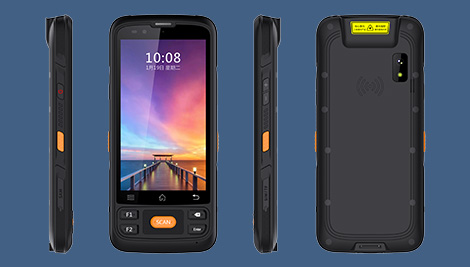
1. Data Collection and Real-Time Transmission: Building the Production Information Highway
The core function of an industrial PDA is to achieve real-time collection and seamless transmission of production data. By integrating high-precision barcode scanning engines and RFID reading/writing modules, the device can quickly identify one-dimensional codes, two-dimensional codes, and UHF electronic tags, covering key information such as material batches, equipment parameters, and process data. For example, after a certain auto parts manufacturer deployed PDA production traceability data collectors in its assembly workshop, workers could scan the vehicle frame number to automatically retrieve assembly drawings, and torque wrench readings were transmitted in real time to the MES system via Bluetooth. When abnormal values were detected, the device immediately triggered an alarm and locked the process flow, reducing rework rate by 15% and saving 25 minutes per vehicle assembly.
In terms of data transmission, modern industrial PDAs support multiple communication protocols such as 5G, Wi-Fi 6, and Bluetooth 5.0, ensuring real-time upload of data to enterprise ERP or cloud platforms. An electronics manufacturer achieved dynamic warehouse management by integrating PDA with WMS: when receiving materials, scanning the material QR code automatically verified the BOM list; when issuing materials, RFID tunnel gates read pallet tags in batches, and inventory data was synchronized to the ERP system. This improved inventory accuracy to 99.9% and reduced inventory counting time by 70%. Such a real-time data stream breaks the information silos of traditional manufacturing and provides decision-making basis for management.
2. Production Process Traceability: Full-Chain Quality Control System
The application of PDA in production traceability is reflected in three dimensions:
Material Traceability: Using unique identification codes (such as QR codes, RFID tags) to record the entire process from raw material receipt to finished product. A food company using PDA combined raw material batch scanning registration with real-time production parameter collection. When a quality problem occurred in a certain batch, the source could be located within 10 minutes, reducing quality losses by 50%.
Process Management: PDA records the operator, equipment status, and environmental parameters for each process. An automotive factory deployed explosion-proof PDAs on the assembly line. After workers scanned the workstation QR code, the system automatically pushed electronic work instructions and recorded bolt tightening torque, assembly time, and other data, reducing process mismatch rate by 90%.
Equipment Monitoring: PDA integrated with vibration sensors and temperature sensors can collect equipment operating data in real time, and combined with edge computing technology, can achieve predictive maintenance. A chemical company used PDA to monitor reactor vibration frequency; when parameters deviated from thresholds, maintenance orders were automatically triggered, reducing unplanned equipment downtime by 40%.
3. Material Management and Inventory Optimization: From Precision Distribution to Dynamic Control
The value of PDA in warehousing and logistics is reflected in:
Precision Distribution: By integrating with electronic Kanban systems, PDA production traceability data collectors can display real-time material demand for each production line. After a home appliance company adopted PDA, delivery personnel executed JIT (Just In Time) supply based on location information prompted by the device, increasing inventory turnover by 20% and reducing line-side storage area by 30%.
Dynamic Inventory: PDA supports mobile inventory counting and cycle counting. A 3C electronics company used RFID-PDA combination to achieve "inventory when receiving." Warehouse managers could complete data collection while walking with the handheld device, reducing annual downtime losses by over 2 million yuan.
Error-Proof Mechanism: PDA contains built-in validation rules that automatically match material batches with system BOM. A medical device manufacturer eliminated approximately 1.2 million yuan in material mismatch losses annually through this function, reducing defect rate by 25%.
4. Durability Design: Adapting to Complex Industrial Environments
The reliability of industrial PDA is reflected in:
Physical Protection: Designed with IP65 protection rating, can withstand drops from 1.5 meters and dust environments. A logistics company test showed that the device still operates stably under extreme temperatures from -20°C to 60°C, maintaining scanning accuracy of 99.9%.
Battery Life: Equipped with 5000mAh or larger batteries, supports hot-swap and fast charging. A courier company equipped solar-charging PDAs for township outlets, allowing 10 hours of continuous operation in areas without grid power, increasing daily processing capacity by 3 times.
Modular Expansion: Supports NFC, fingerprint recognition, and other modules that are plug-and-play. A power maintenance team added laser distance measurement modules, improving insulator inspection efficiency by 3 times and reducing fault location time by 55%.
5. System Integration and Customization: Seamless Connection to Enterprise IT Architecture
The value of industrial PDA lies not only in hardware performance but also in its open system integration capability:
API Integration: Supports interaction with mainstream ERP systems via RESTful APIs. An auto parts manufacturer achieved millisecond-level synchronization of PDA data with MES through this method, improving production reporting efficiency by 60%.
Customized Applications: Android-based PDA can run enterprise self-developed apps. A clothing brand developed a PDA fitting room management system. When a garment stayed in a fitting room for over 20 minutes, the system automatically pushed matching suggestions to staff devices, increasing add-on sales rate by 19%.
Multi-Device Collaboration: Through Bluetooth connection with printers, scanners, and other peripherals, a construction site manager used PDA to scan rebar QR codes and directly print quality inspection reports, saving 280,000 yuan in management costs annually.
6. Industry Application Case Studies
Automotive Manufacturing: A car manufacturer deployed chemical-resistant PDAs in its paint shop. Workers scanned the vehicle body QR code, and the system automatically matched paint formulas and controlled spray robot parameters, reducing color error rate from 2.5% to 0.01%.
Food Processing: A dairy company used PDA to record farm information, processing temperatures, and quality inspection data for each batch of milk, achieving full chain traceability from farm to table, raising product sampling pass rate to 99.9%.
Pharmaceutical Industry: A pharmaceutical company used medical-grade PDAs on the packaging line. After scanning the electronic supervision code on the drug box, data was automatically uploaded to the national drug traceability platform, reducing recall response time from 72 hours to 2 hours.
7. Selection Suggestions and Future Trends
When selecting a PDA production traceability data collector, enterprises should focus on:
Scanning Performance: Choose devices with decoding speed ≥300 times/hour and support for DPM code reading.
System Compatibility: Confirm that the device supports the communication protocols of existing IT systems.
Expansion Capability: Prioritize models that support 5G, edge computing, and other new technologies.
Future industrial PDAs will develop toward greater intelligence:
AI Empowerment: PDA integrated with machine vision can automatically identify defects. An electronics factory test showed this function improved AOI detection efficiency by 40%.
Digital Twin: Data collected by PDA can build virtual production lines for process simulation and optimization.
Low-Code Development: Some manufacturers have launched visual configuration tools, allowing enterprises to customize PDA applications without programming.
As the cornerstone of manufacturing digital transformation, the industrial PDA production traceability data collector is redefining the efficiency boundaries of production management through its powerful data collection capabilities, rigorous industrial design, and open integration features. With the integration of technologies such as 5G and AI, PDA will evolve from a single data collection tool to the nerve endings of intelligent production systems, providing core support for enterprises to build real-time, transparent, and traceable manufacturing systems.