

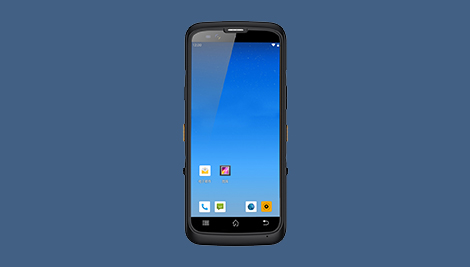
In today's accelerating digital transformation, industrial handheld PDA verification terminals, as core devices for mobile data collection and processing, are redefining on-site operational efficiency with industrial-grade performance and multifunctional integration. This article focuses on their core functional architecture, exploring dimensions such as data collection, communication capabilities, and environmental adaptability, revealing how this equipment serves as a key support for enterprise digital transformation.
I. Multi-dimensional Data Collection: Full-scenario Coverage from Barcodes to Biometrics
1.1 Basic Data Collection Capabilities
Handheld PDA verification terminals come standard with high-precision barcode scanning modules, supporting rapid recognition of one-dimensional codes (such as Code39, UPC) and two-dimensional codes (like QR Code, PDF417). Devices using CCD imaging technology achieve a 0.1-second response time, enabling scanning efficiency of 3,000 packages per hour in logistics sorting centers. Industrial-grade RFID reading and writing modules further break physical limitations, supporting batch reading of ultra-high frequency (UHF) tags at distances of up to 5 meters. Real-world tests in an e-commerce warehouse showed that a single scan can simultaneously identify information from 120 items, increasing inventory efficiency by 8 times compared to traditional manual methods.
1.2 Biometric Verification Technologies
Integrated FAP-level optical fingerprint modules and dual-camera facial recognition systems build a multi-modal identity verification system. In a case study at a bank branch, the device used an offline algorithm package to implement dual verification via voiceprint and facial recognition, reducing remote account opening fraud risk by 92%. Notably, its non-contact design proves valuable in medical scenarios, where nurses can complete medication verification by scanning patient wristband barcodes, avoiding manual entry errors.
1.3 Dedicated Module Expansion
Modular design grants the device high customizability:
Financial payment module: Integrates SE security chips, supporting UnionPay QuickPass and third-party payments.
Industrial sensor interfaces: RS232/RS485 serial ports can connect to temperature and humidity sensors.
Printing components: Built-in thermal printers enable real-time output of adhesive labels.
II. Full-link Communication Capabilities: Building Real-time Data Streams
2.1 Multi-standard Network Support
Industrial handheld PDA verification terminals support 5G/4G full-network compatibility, Wi-Fi 6, and Bluetooth 5.2 protocols. In an application at a multinational logistics company, 5G networks achieved millisecond-level synchronization of cross-border package tracking. Dual-band Wi-Fi modules maintained 85% signal strength after penetrating three concrete walls in warehouse environments, ensuring real-time responses for AGV scheduling systems.
2.2 Offline Operation Fault Tolerance Mechanism
For network-blind areas, the devices feature built-in 128GB storage, capable of caching 72 hours of operational data. When network recovery is detected, incremental synchronization technology transmits only changed data. Tests in an electricity inspection project showed this mechanism maintains data integrity.
2.3 Positioning Service Integration
Beidou/GPS dual-mode positioning modules achieve sub-meter accuracy. In an urban parking management application, linking with geomagnetic sensors reduced illegal parking evidence collection time. AGPS-assisted positioning technology ensures positioning errors within 1 meter even in complex environments like underground garages.
III. Industrial-grade Reliability Design
3.1 Extreme Environment Adaptability
Devices pass IP65 protection certification. In tests at a port terminal, the barcode scanning module maintained a 99.8% recognition rate after 72 hours of continuous salt spray exposure. Drop testing standards extend to 1.5 meters across six surfaces, with a courier company reporting annual device failure rates below 0.3%.
3.2 Ergonomics Optimization
A 5-inch transmissive backlit screen maintains 800-nit brightness in outdoor sunlight. A glass-like touch panel withstands 100,000 scratch tests without marks and supports glove operation modes. Feedback from a manufacturing enterprise showed a reduction in operator wrist fatigue after 8 hours of continuous use.
3.3 Battery Life Management Innovation
A 5000mAh removable battery supports QC4.0 fast charging. Tests in a retail enterprise revealed that 15 minutes of charging in fast mode enables 4 hours of continuous operation. Intelligent power management systems dynamically adjust CPU frequency, achieving 12 hours of continuous work per shift in hospital ward inspection scenarios.
IV. Security System and Expansion Ecosystem
4.1 Full-link Data Protection
Handheld PDA verification terminals use hardware-accelerated SM4 national cryptographic algorithms. In a government hall application, end-to-end encryption for ID information transmission was implemented. Remote wipe functions can clear sensitive data within 30 seconds if the device is lost; tests at a financial institution showed this mechanism effectively prevents data leaks.
4.2 Open Platform Architecture
A complete SDK development kit supports multi-language development in C++, Java, and Python. A logistics enterprise achieved seamless integration with WMS systems through custom development, boosting inbound and outbound efficiency. Devices support OTA wireless updates, with a supermarket chain completing 23 functional iterations annually without service interruption.
4.3 Global Compliance Support
Devices pass multiple certifications including CE, FCC, and RoHS. Pre-installed multi-language packs enable real-time switching between English, Thai, and Vietnamese in Southeast Asian markets. Compliance with GDPR data sovereignty requirements helped a cross-border e-commerce platform pass EU market access audits.
V. Industry Application Practices
5.1 Smart Logistics
After deployment at a courier enterprise, results included:
Collection phase: Dual verification via ID and facial recognition achieved zero error in real-name rates.
Transportation phase: Real-time binding of GPS tracking and electronic waybills reduced package loss rates.
Delivery phase: Fingerprint-based delivery confirmation lowered dispute rates.
5.2 Intelligent Manufacturing
In an automotive parts factory application:
Production line: Scanning part barcodes automatically invoked machining parameters.
Quality inspection: Bluetooth connections to testing equipment enabled automatic data uploads to MES.
Warehousing: RFID channel machines achieved zero-error in finished goods outbound processes.
5.3 Public Services
Integration in a smart city project led to:
Administrative approval: ID reuse technology cut form-filling time by 50%.
Market supervision: Bluetooth-linked portable rapid testing devices uploaded results in real time.
Emergency management: IP-rated designs ensured continuous data collection in disaster zones.
VI. Selection Decision Dimensions
Key factors for purchasing include:
Processor performance: An eight-core CPU with 4GB RAM ensures smooth operation of complex applications.
Scanning engine: Excellent performance in recognizing damaged or soiled barcodes.
Expansion capabilities: SIM card slots and TF card expansion meet multinational operation needs.
After-sales network: A nationwide warranty system guarantees 48-hour repair responses.
Industrial handheld PDA verification terminals are evolving from simple data collection tools into mobile intelligent terminals. Their modular design, industrial-grade reliability, and open ecosystem provide enterprises with a complete data chain from on-site operations to management decisions. As 5G and IoT technologies deepen, these devices will further integrate into scenarios like smart factories and digital governance, becoming indispensable infrastructure for industrial digital transformation.