

Under the drive of the digital wave, identity verification has evolved from traditional counter-based models to mobile and intelligent directions. As a core device in the mobile verification field, handheld verification terminal PDAs are reshaping operational models in public security law enforcement, financial risk control, and government services by integrating multiple identity verification technologies. This article will analyze how such devices build efficient and precise identity verification solutions from three dimensions: technical architecture, scenario applications, and security systems.
I. Integration and Innovation of Multimodal Verification Technologies
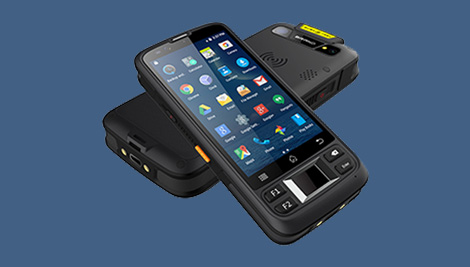
Handheld verification terminal PDAs have broken through single verification modes to form a triple verification system: "ID verification + facial/fingerprint biometric comparison + data interaction." Its core verification process includes three technical layers:
1.Document Information Collection Layer
Using RFID/NFC technology to read the chip embedded in ID cards, it decrypts information through Ministry of Public Security-certified encryption modules, supporting both online and offline verification modes. The device's optical character recognition module extracts key fields from non-chip documents like passports and driver's licenses. Combined with fuzzy recognition algorithms, it accurately captures core information such as name, ID number, and validity period even under conditions of slight document damage or insufficient lighting.
2.Biometric Comparison Layer
Equipped with professional-grade fingerprint recognition modules compliant with the Ministry of Public Security's GA/T 1012-2012 standard, its 508dpi resolution capacitive sensor captures fine fingerprint features. Paired with liveness detection algorithms, it effectively prevents forgery methods like silicone fingerprint molds. The facial recognition system employs 3D structured light technology, using infrared cameras to collect facial depth information, maintaining a 99.9% recognition accuracy rate in strong light or backlight environments.
3.Real-time Data Interaction Layer
Built-in with 4G/5G dual-mode communication modules and Beidou/GPS dual-mode positioning chips, verification data is encrypted via the national cryptographic SM4 algorithm and transmitted to public security databases. In a smart policing project, the device completed the entire process—including document reading, biometric comparison, and database verification—in under 0.3 seconds, with daily processing capacity exceeding 800 people.
II. Deep Application Practices in Typical Scenarios
1.Public Security Mobile Law Enforcement Scenarios
During patrols at transportation hubs, police officers use the "person-document verification" function of handheld verification terminal PDAs to quickly confirm the identities of suspicious individuals. The device's built-in fugitive database, with real-time updates, triggers immediate alerts upon successful matches. In one provincial deployment of 2,000 units, street inspection efficiency increased by 300%.
2.Financial Risk Control Systems
Bank customer managers use the PDA's "triple verification" function during mobile operations: first reading ID chip information via NFC, then comparing on-site facial images with ID photos, and finally verifying dynamic verification codes received via reserved mobile numbers. After deployment at a joint-stock bank, credit card fraud rates fell by 92%, and average customer wait times shortened to 18 seconds.
3.Government Service Innovations
At real estate registration centers, staff use the PDA's "electronic document verification" function to scan QR codes and retrieve electronic property certificates, combined with biometric verification of holders, enabling "zero-material" property transfer procedures. A pilot in Shenzhen reduced processing time per transaction from 45 minutes to 8 minutes, with public satisfaction reaching 99.9%.
III. Multi-level Construction of Security Protection Systems
Addressing risks like device loss and data leaks, handheld verification terminal PDAs build a three-tier security protection mechanism:
1.Hardware-level Security
Using certified security chips to store sensitive data such as fingerprint templates and facial feature values, the device features physical switches to control cameras and microphones, preventing unauthorized collection. It passes IP65 protection tests.
2.System-level Protection
Running an Android-based security-enhanced version integrated with TEE (Trusted Execution Environment), verification applications operate in isolated security domains separate from regular apps. The device supports remote locking and data wiping. Tests by a city public security bureau showed data can be erased within 30 seconds of device loss.
3.Transmission-level Encryption
Employing SM4 national cryptographic algorithms for data encryption with dynamic key negotiation mechanisms. At a border inspection station, devices establish VPN tunnels with backend systems to ensure passenger information isn't intercepted during transmission.
IV. Industry Evolution Trends and Challenges
With the deepening implementation of personal information laws, handheld verification terminal PDAs are evolving in two directions:
1.Privacy Protection Technology Upgrades
Some devices now integrate federated learning frameworks to complete feature comparisons locally without transmitting raw biometric data. A company's "distributed verification" solution splits facial feature values into encrypted fragments stored separately, exchanging only encrypted fragments during comparisons to eliminate data leakage risks technically.
2.Extreme Environment Adaptability Enhancements
For harsh northern winters at -20°C, low-temperature battery versions with self-heating screen technology ensure outdoor operation. Devices deployed on South China Sea reefs withstand 95% humidity and salt spray corrosion through special anti-corrosion treatments.
As foundational devices for mobile identity verification, handheld verification terminal PDAs continuously evolve around the core dimensions of "precision, security, and efficiency." With the integration of cutting-edge technologies like edge computing, these devices will play a more critical role in digital identity authentication systems, providing strong support for building a trustworthy digital society.