

In logistics, retail, and healthcare sectors, data collection efficiency directly impacts operational costs and customer satisfaction. Traditional manual entry suffers from high error rates (averaging 5%), while consumer devices fail in industrial environments. Industrial PDAs — purpose-built with hardened hardware and intelligent software — are becoming the backbone of digital transformation. This whitepaper analyzes their technical advantages, implementation scenarios, and selection methodologies.
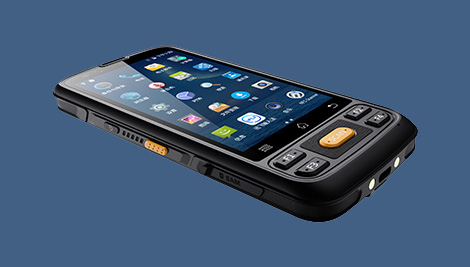
1. Why Industrial PDAs Outperform Consumer Devices
Efficiency Breakthroughs
Problem: Handheld scanners require PC pairing, causing data gaps in mobile workflows. Smartphones lack speed (1-2s/scan) and fail in extreme conditions (-20°C/strong light).
Solution: Industrial PDAs feature multi-mode recognition (1D/2D barcodes, RFID/NFC) with 0.1s response time, operable in -30°C to 50°C ranges.
Seamless System Integration
Challenge: Custom coding for ERP/WMS integration increases deployment costs by 30-50%.
Solution: Pre-installed Android/Windows OS with API customization enables plug-and-play connectivity for SAP, Oracle, and local systems like Yonyou.
Military-Grade Durability
1.8m drop resistance and IP67 ratings (vs. consumer IP54) ensure 3-5 year lifespans in warehouses/manufacturing.
2. Core Technologies Explained
Scanning Engines: Precision Engineering
Laser/Red Light: Cost-effective but struggles with reflective surfaces.
CMOS Imaging: Reads damaged/wrinkled barcodes (success rate >99.5% in logistics).
Case Study: A German automaker reduced misreads by 40% using algorithmic decoding for curved metal parts.
OS Architecture: Security vs Flexibility
Android 12: Supports rapid app development but requires additional encryption.
Windows IoT: Ideal for legacy systems but limits cloud integration.
Hybrid Systems: Dual-boot options balance compliance (e.g., HIPAA) and functionality.
Battery Innovations
8,000mAh hot-swappable batteries with 30W fast charging sustain 24/7 operations.
3. Real-World Applications
Logistics Optimization
Inbound: Auto-matching purchase orders reduces receiving errors by 90%.
Inventory: RFID-enabled dynamic cycle counting achieves 0.001% variance.
Outbound: Route optimization cuts driver idle time by 35%.
Retail Revolution
Shelf Audits: Automated discrepancy alerts shrink stockouts by 25%.
O2O Integration: Scan-to-order bridges eCommerce and physical stores.
Healthcare Compliance
Medication Safety: FDA-compliant PDAs block expired drugs with 100% traceability.
4. Procurement Checklist
Priority Mapping
Light-duty (retail): 5” displays with 12hr battery.
Heavy-duty (manufacturing): MIL-STD-810G certified.
Hidden Cost Factors
SDK Availability: Ensures future-proof customization.
ROI Calculation:
oDirect: 1 PDA replaces 3 workers ($15/hr × 2,080hr/yr).
oIndirect: 20% faster inventory turnover reduces capital ties.
5. Future Trends
AI Vision: Auto-classify items without barcodes (beta testing shows 92% accuracy).
5G Edge Computing: Local data processing slashes cloud latency by 80%.
Conclusion: The Strategic Imperative
Industrial PDAs transcend hardware — they’re neural endpoints for digital ecosystems. Selecting the right solution requires evaluating not just specs, but how it transforms workflows. When a PDA becomes your team’s extended senses, the ROI extends far beyond error reduction.