

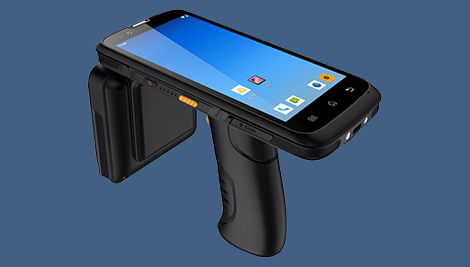
In the rapidly evolving e-commerce industry, warehouse management has become a critical factor determining corporate competitiveness. Faced with daily order volumes reaching tens of thousands, the dynamic flow of massive SKUs, and consumers' stringent demands for logistics speed, traditional warehouse operations increasingly reveal efficiency bottlenecks. The widespread application of Ultra-High Frequency (UHF) Handheld PDAs (Personal Digital Assistants) is driving an efficiency revolution powered by technology in e-commerce warehouse management.
I. Pain Points in E-commerce Warehouse Management and the Need for Intelligent Upgrades
The unique challenges of e-commerce warehousing manifest in three core areas:
Extreme Order Fluctuations: Sales events like Double 11 and 618 cause order volumes to spike exponentially, overwhelming traditional manual operations.
Soaring SKU Complexity: A vast variety of products with significant specification differences leads to increased picking error rates and inventory management difficulties.
Stringent Timeliness Requirements: Every step from order generation to packing and shipping is time-critical; any delay can impact consumer experience.
Traditional warehouse management, reliant on manual scanning, paper-based documentation, and fixed terminals, suffers from three major drawbacks:
Data Delay: Manual entry and system synchronization create time lags, hindering real-time inventory visibility.
Operational Limitations: Fixed scanners restrict mobility and reduce the efficiency of mobile tasks.
Low Fault Tolerance: Human fatigue leads to mis-scans and missed scans, causing inventory data inaccuracies.
The emergence of UHF Handheld PDAs is designed to solve these very challenges. By integrating UHF RFID (Radio Frequency Identification) technology, barcode scanning, wireless communication, and intelligent operating systems, they transform warehouse operations from "man-to-goods" to "goods-to-man," upgrading from "passive response" to "intelligent decision-making."
II. Core Technical Advantages of UHF Handheld PDAs
1.UHF RFID Technology: Penetrative Identification & Batch Processing
2.Unlike traditional barcode scanning requiring precise alignment with each label, UHF RFID technology enables batch reading of tag information within a 3-25 meter range, even penetrating non-metallic materials like cardboard and plastic packaging. In scenarios like bulk inventory counting or multi-item sorting, a single scan can capture data for hundreds of items, increasing efficiency by over 10 times.
3.Full-Scenario Mobile Operation Capability
4.The lightweight design (typically ≤500g) and long-lasting battery (over 8 hours of continuous operation) allow warehouse personnel to carry the PDA seamlessly between receiving, storage, picking, and packing areas. Combined with 4G/5G or Wi-Fi 6 technology, data is uploaded in real-time to the WMS (Warehouse Management System), achieving zero-delay "scan-and-sync" management.
5.Intelligent Interaction and Error-Prevention Mechanisms
6.The built-in industrial-grade scanning engine automatically recognizes damaged or wrinkled barcodes. Coupled with the PDA's vibration feedback, voice prompts, and screen highlighting, it instantly alerts operators to errors. For example, if a picker places an item in the wrong bin, the device immediately issues an alarm and displays the correct location, reducing human error rates to below 0.1%.
7.Anti-Interference and Durability Design
8.Designed for harsh warehouse environments with dust, vibration, and drop risks, professional-grade PDAs feature IP65 ratings (dust and water resistance), Corning Gorilla Glass screens, and rubberized shock-absorbing casings, capable of withstanding drops from 1.5 meters onto concrete. They operate stably in extreme temperatures from -20°C to 60°C, perfectly suiting specialized scenarios like cold chain storage.
III. End-to-End Application of UHF Handheld PDAs in E-commerce Warehousing
1.Intelligent Receiving: From "Manual Checking" to "Auto-Verification"
Vehicle Positioning: Scanning the truck's RFID tag with the PDA automatically matches the purchase order and optimizes dock assignment.
Batch Acceptance: Using RFID gate readers or handhelds to batch-scan pallet tags verifies the quantity, batch, and expiration of an entire pallet within 10 seconds.
Anomaly Alerts: Discrepancies between received goods and system data trigger immediate locks on the shipment and push exception handling workflows.
2.Dynamic Picking: From "Man-to-Goods" to "Goods-to-Man"
Wave Strategy Optimization: The PDA automatically generates picking waves based on order structure (single item, multiple items, full case), guiding operators along optimal paths.
Smart Picking: Scanning a tote's tag prompts the system to light up the corresponding bin's LED indicator and display the required quantity, enabling paperless picking.
Recheck Verification: At the packing station, the PDA performs a secondary scan of the item and order barcode, ensuring zero mis-shipments.
3.Accurate Counting: From "Shutdown Inventory" to "Dynamic Cycle Counting"
RFID Dynamic Counting: Operators walk aisles with the PDA, which automatically reads all RFID tags within range. A full inventory of a 500㎡ warehouse can be completed in about 30 minutes.
Discrepancy Tracing: The system automatically compares count data with inventory records, generates variance reports for responsible personnel, and supports historical data review.
4.Outbound Management: From "Sequential Operation" to "Parallel Processing"
Staging Area Allocation: Based on order priority and vehicle ETA, the PDA intelligently assigns staging locations and generates loading sequences.
Electronic Proof of Delivery: Carriers scan the digital waybill on the PDA to confirm receipt, with data sent in real-time to the TMS (Transportation Management System) for full supply chain visibility.
IV. Three Key Strategies for Implementing UHF Handheld PDAs
1.Integrated Hardware-Software Deployment
Device Selection: Choose PDA models based on warehouse size, network coverage, and product characteristics.
System Integration: Ensure seamless integration with WMS, ERP, and OMS for real-time, bidirectional data sync.
Network Optimization: Deploy high-density Wi-Fi 6 Access Points or 5G private networks to eliminate dead zones.
2.Operational Process Re-engineering
Standardized SOPs: Embed PDA operational steps into work instructions.
Dynamic Dashboards: Set up digital displays showing real-time progress and device status.
Flexible Scheduling: Use PDA-collected labor data to model workforce needs based on order volume.
3.Employee Empowerment and Motivation
Immersive Training: Use VR simulations for practice in a virtual warehouse environment.
Gamified Performance: Convert metrics like accuracy and speed into scores and recognize top performers.
Data Empowerment: Provide employees access to personal performance dashboards to encourage process optimization.
In the competitive arena of e-commerce warehousing, the UHF Handheld PDA is no longer an optional accessory but essential infrastructure. It acts like a precision scalpel, cutting through the efficiency bottlenecks of traditional warehousing, and functions as an intelligent nervous system, connecting every cell of the warehouse into a collaboratively operating entity. For businesses, deploying PDAs is not the final goal but the starting point for building an intelligent logistics ecosystem. When data flows freely between devices and decisions are driven by algorithms, warehouse management truly transforms from a cost center into a value engine.