

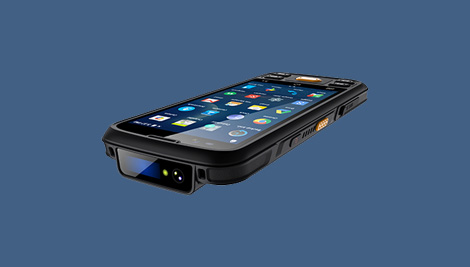
In the era of Industry 4.0 with deep Internet of Things (IoT) penetration, smart electronic shelves are becoming the core infrastructure of supply chain management. These intelligent terminals, which integrate sensors, communication modules, and data analysis, are achieving an innovative transition from "passive storage" to "active management" through the deep integration of Industrial Data Collector PDA Handheld Devices. This article systematically analyzes the innovative application of PDAs in smart electronic shelves from three dimensions: technical architecture, application scenarios, and efficiency improvement.
I. Technical Architecture: Building the Neural Center of IoT Perception
The core of the smart electronic shelf lies in its IoT perception capability, and the PDA, as a mobile data collection terminal, plays a key role as the neural center. Through the following technical combinations, the PDA and shelf system achieve deep synergy:
1.Multi-modal Data Collection
PDA integrates various identification technologies such as barcode scanning, RFID reading/writing, and NFC, compatible with multiple carriers on shelves like 1D codes, QR codes, and UHF tags. For example, in high-density storage scenarios, PDA's large depth-of-field scanning engine can accurately read tiny barcodes (as small as 5mil) on high-level shelves up to 8 meters, with a missed scan rate below 0.03%. This multi-modal recognition capability ensures that every item on the shelf is uniquely identified, laying the foundation for fully digital management.
2.Wireless Communication Protocol Fusion
Industrial Data Collector PDA Handheld Devices interact in real-time with the shelf management system via wireless communication technologies like Wi-Fi and 4G/5G. In industrial environments, the application of 5G private networks reduces PDA data transmission latency to below 10ms, while supporting batch identification of multiple tags within a 15-meter range. This high-speed, stable communication capability ensures real-time synchronization of inventory data and instant response to instructions.
3.Enhanced Edge Computing Capability
The new generation of PDAs integrates edge computing modules, enabling local data preprocessing and anomaly detection. For instance, using image recognition algorithms to automatically identify the display status of goods on shelves; when product misplacement or out-of-stock is detected, warnings are immediately generated and pushed to management terminals. This distributed computing architecture effectively reduces the load on cloud servers and improves system response speed.
II. Application Scenarios: Unlocking Multiple Values of Intelligent Management
The application of PDAs in smart electronic shelves covers the entire industrial chain from production to consumption. The following is an in-depth analysis of typical scenarios:
1.Smart Warehouse Management
In high-bay rack warehouses, PDA's long-range scanning function completely solves the problem of manual high-altitude inventory counting. Test data from a logistics company shows that after deploying PDAs, inventory counting efficiency for high-level shelves increased by 75%, and inventory accuracy improved from 92% to 99.9%. Through seamless integration with the WMS system, PDAs also enable dynamic route planning—when a picking order is received, an optimal picking route is automatically generated, and staff are guided via voice navigation to complete tasks quickly, increasing picking efficiency by over 40%.
2.Smart Manufacturing Collaboration
In automotive manufacturing workshops, smart tool cabinets use PDAs to achieve full lifecycle management of tools. When employees check out tools, the PDA scans the RFID tags on the shelf, automatically associates the work order information, and records data such as checkout time and personnel. If tools are not returned according to procedure, the system automatically locks permissions for the next process, thereby preventing production line stagnation due to missing tools. This refined management model reduced tool loss rate to zero in an auto parts factory and shortened production preparation time by 60%.
3.New Retail Scenario Innovation
Smart shelves in convenience stores use PDAs for dynamic inventory management. When a customer picks up a product, pressure sensors on the shelf trigger the PDA to scan RFID tags, updating inventory data in real-time. When inventory falls below a preset threshold, the PDA automatically sends a replenishment request to the supplier and generates an instruction to update electronic shelf labels, ensuring synchronized price information and inventory status. This automated process reduced the out-of-stock rate by 50% and increased inventory turnover rate by 30% in a chain convenience store.
III. Efficiency Improvement: Reshaping the Boundaries of Supply Chain Efficiency
The deep integration of Industrial Data Collector PDA Handheld Devices and smart electronic shelves is creating significant efficiency improvements in supply chain management:
1.Leap in Operational Efficiency
Traditional manual inventory counting, requiring 3 people and 4 hours for 2000 items, can be completed by just 1 person in 5 minutes using PDA's wireless scanning function. In inbound/outbound processes, PDA's automatic identification capability increases goods processing speed by 3-5 times, while avoiding issues like over-picking, under-picking, or mis-picking caused by manual operations.
2.Data Quality Optimization
PDA's real-time data collection function reduces the update delay of inventory data from hours to seconds. A retail enterprise, by deploying PDAs and smart shelf systems, improved inventory accuracy from 85% to 99.9%, and reduced replenishment costs due to missed/wrong scans by 65%. This precise data support enables enterprises to forecast market demand more accurately and reduce dead stock accumulation.
3.Security Control Upgrade
In confidential document management scenarios, PDAs combined with biometric technologies (such as fingerprint, facial recognition) enable hierarchical permission management. Ordinary employees can only view basic file information, while authorized personnel require dual authentication to unlock encrypted content. When a document leaves the controlled area, the PDA and shelf system linkage trigger sound and light alarms and track the document's location in real-time, achieving a full closed-loop security control.
IV. Future Trends: Innovation Driven by Technological Fusion
With the development of 5G, AI, digital twin, and other technologies, the integration of PDAs and smart electronic shelves will present the following trends:
1.5G + UHF Converged Application
The high bandwidth and low latency of 5G networks will drive the application upgrade of UHF RFID technology. Future PDAs will support more complex multi-tag recognition algorithms, achieving stable reading of 300 tags per second in dense shelf environments, and transmitting data to the cloud in real-time via 5G for in-depth analysis.
2.AI-Enabled Intelligent Decision-Making
Using machine learning algorithms, PDAs can predict inventory needs based on historical data and automatically generate replenishment work orders. For example, in cold chain logistics, PDAs combined with temperature sensor data dynamically adjust goods storage locations to ensure the quality and safety of perishable goods. This intelligent decision-making capability will shift supply chain management from "experience-driven" to "data-driven."
3.Virtual-Physical Mapping via Digital Twin
Leveraging digital twin technology, PDAs can map the real-time status of physical shelves into virtual space. Managers can remotely monitor shelf parameters like inventory, temperature, and humidity through a 3D visualization platform, and simulate material scheduling schemes in the virtual environment to optimize storage layout in advance. This virtual-physical integrated management model will significantly enhance the agility and flexibility of the supply chain.
Conclusion
The combination of Industrial Data Collector PDA Handheld Devices and smart electronic shelves is reshaping the underlying logic of supply chain management. From innovation in technical architecture to the expansion of application scenarios, from the improvement of operational efficiency to the upgrade of security control, this integration is not merely a simple stacking of devices but a comprehensive innovation in management philosophy and operational models. As technology continues to evolve, PDAs will further break through physical boundaries, becoming the core hub connecting the physical and digital worlds, and driving intelligent supply chains towards higher levels of intelligence and flexibility. In this industry innovation driven by technology, only by actively embracing innovation can enterprises gain a competitive edge in the fierce market.