

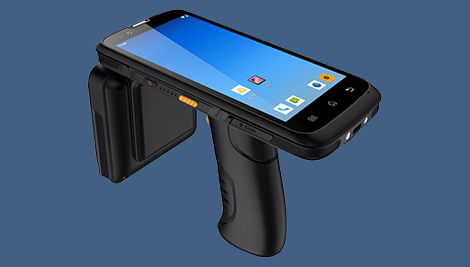
In industrial manufacturing, warehousing and logistics, and retail distribution, inventory management remains a core component of operational efficiency. Traditional manual inventory methods suffer from low efficiency, high error rates, and delayed data updates, which have become bottlenecks in achieving lean management. The emergence of the 25-meter long-range industrial RFID handheld terminal PDA has brought innovative breakthroughs to inventory management by deeply integrating RFID technology with mobile terminals.
1. Technological Innovation: Core Advantages of RFID Handheld Terminals
The industrial RFID handheld PDA integrates high-frequency/UHF RFID read/write modules, barcode scanning engines, industrial-grade processors, and high-precision sensors, offering multiple technical advantages:
Bulk Tag Reading Capability
Unlike traditional barcode scanning, which requires line-of-sight alignment, the RFID PDA can read over 200 tags per second. In apparel warehousing, staff can automatically collect RFID tag data from entire boxes of goods while walking between shelves, increasing inventory efficiency by over 80%, with a read range of up to 25 meters.
Penetrative, Non-Contact Identification
RFID signals can penetrate non-metallic materials like paper and plastic, functioning reliably in complex environments such as metal shelving or liquid containers. One automotive parts manufacturer embedded RFID tags in metal toolboxes and used the handheld terminal's penetration feature to achieve precise tool tracking.
Full-Scene Data Interaction
With Wi-Fi/4G/5G support, scanned data is instantly uploaded to ERP/WMS systems. A 3C electronics manufacturer linked the handheld terminal with its MES system to monitor real-time material consumption on production lines, improving inventory turnover by 35%.
Industrial-Grade Protection
With IP65 dust and water resistance and 1.5-meter drop protection, it operates reliably in extreme temperatures from -20°C to 60°C. In cold chain warehouses, the device continues to function for over 8 hours in -10°C environments, ensuring uninterrupted inventory operations.
2. Application Scenarios: Full-Coverage from Warehousing to Production
1. Smart Warehouse Management
In automated storage systems, the 25-meter RFID PDA works in tandem with warehouse slot management:
Scans pallet tags during inbound to auto-assign storage locations
Uses area positioning during inventory to quickly identify in-stock items
Verifies loading lists during outbound to prevent errors
A pharmaceutical logistics company reduced its inventory cycle from 7 days to 12 hours and achieved 99.99% accuracy.
2. Production Line Material Control
In automotive assembly workshops, the handheld terminal enables:
Real-time tracking of AGV-delivered material batches
Scanning RFID tags at workstations to trigger assembly instructions
Recording material usage for automatic replenishment via kanban systems
One home appliance manufacturer saw a 62% reduction in production downtime and a 4x improvement in material traceability.
3. Fixed Asset Management
For asset-intensive enterprises, the device supports:
Bulk scanning of server tags to auto-generate asset lists
Recording inspection routes for digital maintenance logs
Tracking large equipment via BeiDou/GPS positioning
A power company shortened its enterprise-wide asset inventory cycle from 3 months to 15 days and reduced asset overstock by 90%.
3. Implementation Essentials: Building an Efficient Inventory System
1. Tag Deployment Strategy
Dynamic tags: Flexible anti-metal tags for fast-turnover goods
Fixed tags: Long-lasting ceramic-based tags for shelves and workstations
Special tags: Low-temperature-resistant tags for cold storage
2. Workflow Optimization
Pre-inventory: Generate optimized scanning paths via system
Execution: Use "grid-based scanning" to avoid duplication
Exception handling: Audio-visual alerts for damaged tags
3. Data Governance Mechanism
Unified tag coding standards for "one item, one code"
Data cleaning algorithms to filter duplicate reads
Three-tier validation: terminal check → system verification → manual sampling
4. Performance Evaluation: Quantifying Management Gains
Metric Traditional Method RFID Handheld Terminal Improvement
Inventory Time 5 people / 3 days 2 people / 4 hours -83%
Labor Cost ¥15,000/session ¥3,000/session -80%
Inventory Accuracy 85% 99.95% +17.6%
Data Delay 24 hours <5 minutes -99.6%
One food processing company saved over ¥2 million annually by reducing near-expiry product loss through precise inventory management.
The 25-meter long-range industrial RFID handheld PDA has evolved from a simple identification tool into a key infrastructure for enterprise digital transformation. By building a collaborative system of "terminal-network-platform," companies can optimize the entire chain from inventory to operational decision-making, gaining competitive advantage. As technology continues to evolve, this smart terminal will unlock even greater value in smart factories and digital twin scenarios.