

In today's wave of digital transformation sweeping across industries, the warehousing and logistics sector is experiencing unprecedented innovation. As a key tool connecting the physical world with digital systems, handheld terminal PDA devices have become an indispensable component of modern warehouse management systems with their efficient, accurate, and flexible characteristics. This article will deeply analyze the core value of handheld terminal PDA devices in the inbound management process from dimensions such as technical features, application scenarios, and management efficiency improvement, providing practical references for enterprises to optimize warehouse processes and build intelligent logistics systems.
Warehouse Management Pain Points and PDA Device Compatibility
Traditional warehouse inbound management has long faced three core challenges:
Low data collection efficiency: Manual entry of goods information is prone to errors and omissions, and paper document circulation is time-consuming;
Insufficient operational process transparency: Delayed updates of goods status lead to inventory data disconnecting from reality;
Slow response to exception handling: Issues such as cargo damage and discrepancies are difficult to trace and locate in a timely manner.
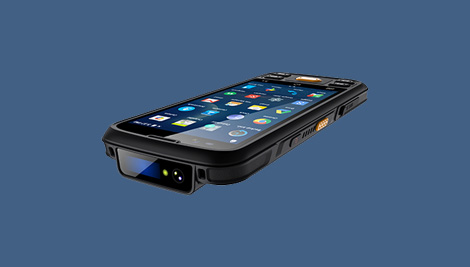
Handheld terminal PDA devices achieve end-to-end digital control from goods receipt to shelf storage by integrating modules such as barcode scanning, RFID reading/writing, and wireless communication. Their industrial-grade three-proof design (dustproof, waterproof, drop-proof) and long battery life better adapt to the high-intensity operational demands in complex warehouse environments.
Core Function Analysis of PDA Devices in Inbound Management
Intelligent Data Collection and Real-time Synchronization
Barcode/RFID dual-mode recognition: Supports scanning of 1D/2D barcodes and reading of UHF RFID tags, completing goods information collection in a single operation, with efficiency improving by more than 5 times compared to manual entry.
Automatic verification mechanism: Through preset rule engines, devices can real-time compare purchase orders with delivery lists, automatically intercepting abnormal goods with mismatched models or quantities, improving acceptance accuracy to 99.9%.
Wireless data transmission: Relying on Wi-Fi/4G/5G networks, data is uploaded in real-time to WMS (Warehouse Management System), ensuring second-level inventory updates.
Dynamic Path Guidance and Precise Positioning
Storage location navigation function: Combining indoor positioning technology, PDAs can plan optimal storage paths and guide operators to quickly complete goods shelving through vibration feedback or voice prompts.
Space optimization algorithm: Automatically recommends optimal storage locations based on goods volume, weight, and turnover rate, helping improve warehouse space utilization by over 30%.
Exception Event Closed-loop Management
Image retention function: Built-in high-definition camera supports photographing and archiving key information such as goods appearance and labels, providing visual evidence for subsequent quality traceability.
Instant messaging module: Problems found during operations can be reported to management with one-click calling through PDA, simultaneously pushing on-site photos and location information, achieving 10-minute response to exception events.
Standardized Inbound Management Process Restructuring
Taking a manufacturing enterprise warehouse as an example, after introducing handheld terminal PDA devices, the inbound process achieved full digitalization:
Pre-inspection stage: Drivers scan delivery note QR codes through PDA, and the system automatically verifies supplier qualifications and historical performance records;
Acceptance stage: Operators scan goods barcodes, and devices simultaneously display inspection items (such as quantity, specifications, production date), automatically comparing net weight through weighing modules;
Shelving stage: PDA recommends storage locations based on goods attributes, scans storage location barcodes to complete binding, and the system automatically generates inventory maps;
Review stage: Management randomly checks key goods through PDA, with data synchronizing in real-time to the quality management system.
This process reduced single-batch goods inbound time from 2 hours to 25 minutes, improved inventory accuracy from 92% to 99.9%, and annually reduced repeated inventory costs caused by information delays by over 200,000 yuan.
PDA Device Selection and Implementation Key Points
Key Hardware Configuration Indicators
Scanning engine: Prioritize industrial-grade scanners supporting multi-code recognition with motion tolerance ≥2m/s;
Protection level: IP65 or higher protection standard, adapting to working temperatures from -20℃ to 60℃;
Battery life: Meeting 12-hour continuous operation requirements, supporting battery replacement operations.
System Integration Strategy
Interface standardization: Ensure PDA operating systems (Android/Windows) achieve data interoperability with WMS and ERP systems through APIs;
Offline caching mechanism: Automatically store operational data during network interruptions, automatically synchronizing upon recovery to ensure business continuity.
Personnel Training System
Scenario simulation training: Simulate exception scenarios through virtual warehouse systems to enhance operators' emergency handling capabilities;
Operation log analysis: Regularly replay PDA-recorded operation trajectories for targeted optimization of operational routes.
For enterprises, deploying PDA devices is not only a technical upgrade but also an innovation in management thinking. By building a collaborative network of "devices-systems-people," warehouse management will achieve a leap from "result recording" to "process control," laying a solid foundation for overall supply chain efficiency improvement.
Conclusion
In an increasingly competitive market environment, the sophistication of warehouse management directly affects enterprise operating costs and customer satisfaction. Handheld terminal PDA devices, with their efficient, accurate, and reliable performance, are reshaping inbound management operational models. For enterprises seeking digital transformation, scientific selection, system integration, and continuous optimization of PDA application solutions will be key steps in building intelligent warehouse systems.