

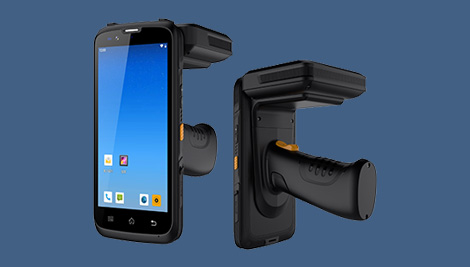
In the retail chain industry, inventory management accuracy and efficiency directly impact operational costs and customer satisfaction. Traditional barcode systems relying on manual item-by-item scanning are not only time-consuming but also prone to data delays and errors during dynamic operations like outbound shipments, shelf replenishment, and stock transfers. With the maturation of IoT technology, RFID (Radio Frequency Identification) handheld terminals have emerged as core tools for optimizing retail supply chains. This article analyzes how RFID PDA devices transform inventory management through real-world applications.
I. Core Challenges in Retail Chain Inventory Management
Outbound Efficiency Bottlenecks
Manual order verification struggles with multi-category, high-volume goods, causing missed scans and mismatches. During peak seasons, delays cascade to store-level shortages.
Shelf Placement Inaccuracy
New arrivals require precise positioning based on sales data. Manual location recording leads to inefficient item retrieval and redundant workflows.
Dynamic Transfer Tracking Gaps
Frequent inter-warehouse/store transfers create "ghost inventory" due to untracked movements, causing systemic data-physical disconnects.
II. Technical Advantages of RFID Handheld Terminals
1. Batch Scanning: From Item-by-Item to Seconds-Long Audits
RFID enables 15-meter range scanning of hundreds of tags simultaneously without line-of-sight. Outbound verification time drops 80% as workers validate entire pallets in one walk-through.
2. Penetrative Reading: Conquering Complex Environments
Unlike barcodes failing on metal shelves or liquid packaging, RFID penetrates wood, plastic, and paper – ensuring reliable reads in congested storage areas.
3. Real-Time Synchronization: Live Inventory Networks
PDA-WMS integration updates stock status instantly. Product transfers trigger automatic system records upon scanning, eliminating manual data entry lags.
III. Application Scenarios in Retail Operations
Scenario 1: Intelligent Outbound Processing
System-guided picking routes optimize worker paths
Mismatch alerts lock shipments upon SKU/quantity errors
Automated digital packing slips replace paper trails
Scenario 2: Smart Shelf Management
Algorithm-driven placement recommendations for new arrivals
Dynamic layout adjustments based on seasonal demand
30% warehouse space recovery via precise slot utilization
Scenario 3: End-to-End Transfer Tracking
Auto-generated inter-store transfer orders upon stockouts
Returns processing with automated resale/repair routing
Unauthorized removal alerts via continuous tag monitoring
IV. RFID Implementation Success Factors
Element Critical Requirements
Device Selection IP65-rated rugged PDAs with multi-frequency (LF/HF/UHF) support
Tag Deployment Material-specific tags (metal-proof/high-temp) + fixed shelf labels
Staff Training Video tutorials with voice-guided PDA operation workflows
Data Security AES-256 encryption + role-based access controls
V. Case Study: Apparel Chain Transformation
A 300-store fashion brand achieved after RFID rollout:
Labor Costs: Reduced by 40%
Daily Orders Processed: 800 → 2,200
Inventory Accuracy: 78% → 99.2%
Stockout Rate: Down 65%
Replenishment Cycle: 7 days → 2 days
VI. Future Evolution
Miniaturization: Thread-embedded tags in clothing labels
Self-Powered Devices: Kinetic energy harvesting batteries
AI Integration: Predictive restocking alerts via sales analytics
Conclusion
RFID handheld terminals have transitioned from optional tools to essential infrastructure in retail. By redefining human-goods-space interactions, this technology builds agile, transparent supply chains that simultaneously cut costs and elevate customer experiences.