

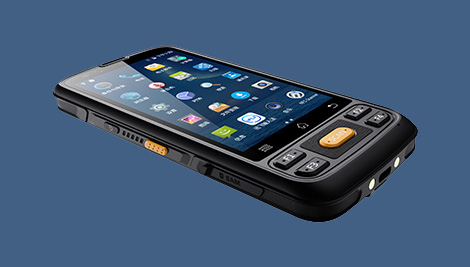
In today's rapidly restructuring global supply chain, handheld PDA data collectors have become core tools for cross-border e-commerce, international logistics, and overseas warehouse operations due to their precise and efficient barcode scanning and automatic inventory data comparison capabilities. As industrial-grade smart devices specifically designed for mobile data collection, they achieve full-process digital management from goods in stock to outbound through technologies like barcode/RFID recognition, wireless communication, and real-time data synchronization, serving as key nodes connecting physical goods with digital systems.
1. Core Technical Features: Precise and Efficient Data Collection Hub
Handheld PDAs adopt industrial-grade design standards, with an IP65 or higher protection rating, able to withstand drops from 1.5 to 2 meters, and adapt to a wide temperature working environment of -20°C to 60°C. They are equipped with a 5000mAh replaceable battery supporting 10 hours of continuous operation; featuring a high-performance processor and large storage combination, they can smoothly run customized Android systems to meet multitasking demands. The device has a built-in 1D/2D barcode scanning engine, supporting global mainstream barcode formats such as UPC/EAN, Code 128, QR Code, with a scanning response time of less than 0.1 seconds, and maintains over 99% recognition accuracy even when facing damaged, blurred, or handwritten barcodes.
In terms of communication capabilities, PDAs support 4G/5G all-network connectivity, dual-band Wi-Fi (2.4GHz & 5GHz), and Beidou/GPS multi-mode positioning, ensuring real-time data synchronization to cloud systems during overseas operations. Taking a European cross-border e-commerce overseas warehouse as an example, using the PDA's batch RFID scanning function, dozens of product information items can be read at once, increasing picking efficiency by 60%, reducing error rates from 5% to 0.01%, and achieving inventory data accuracy as high as 99.9%.
2. Overseas Application Scenarios: Full-Chain Penetration from Logistics to Retail
In Southeast Asian cross-border e-commerce hubs such as Malaysia, Singapore, Vietnam, etc., handheld PDA data collectors have become standard tools for warehouse management. Taking a Malaysian logistics company as an example, it achieves full-process digitization of parcel receipt scanning, inventory counting, and abnormal parcel handling through PDAs. The device seamlessly integrates with WMS systems, supporting real-time data upload and task dispatch, reducing single parcel processing time from 5 seconds to 2 seconds, handling thousands of parcels daily, and lowering labor costs by 30%.
In North American large retail chain enterprises, PDAs are widely used for merchandise inventory, price updates, and membership management. By scanning product barcodes, the system automatically compares inventory data with sales records, enabling dynamic replenishment alerts. After a US supermarket chain adopted PDAs, inventory turnover increased by 25%, stock-out rates decreased by 18%, and customer satisfaction improved by 15%.
In the medical field, overseas hospitals use handheld PDA data collectors for drug traceability and patient information management. Nurses can obtain medical order information by scanning patient wristband barcodes, and pharmacists complete dispensing verification by scanning drug packaging barcodes, effectively avoiding medical errors and enhancing diagnosis and treatment safety.
3. Export Advantages and Global Market Prospects
As the global manufacturing center for PDAs, China's handheld PDA market size reached 68 billion yuan in 2025, a year-on-year increase of 11%. Industrial-grade PDAs account for 68% of the market share, performing prominently in emerging markets such as Southeast Asia, the Middle East, and Africa due to high cost-effectiveness and rapid response capabilities. Through technological innovation, products with multi-language interfaces and compliance with international safety certifications are launched to meet overseas customers' customized needs.
With the integration of 5G and edge computing technologies, the new generation of smart PDAs is developing towards multi-functionality. Devices integrate modules like temperature sensors and pressure monitoring to monitor cold chain goods status in real-time; through open SDK interfaces, they support linkage with smart parcel lockers, AGV robots, and other equipment, building a smart warehousing ecosystem. It is predicted that the global industrial-grade PDA market size will exceed 100 billion US dollars in 2026, with a compound annual growth rate of 8.5%. Chinese manufacturers are expected to achieve greater breakthroughs in the market relying on technological accumulation and cost advantages.
4. Future Trends: Intelligence and Ecological Evolution
Future handheld PDAs will develop towards more intelligent and integrated directions. By optimizing scanning algorithms and path planning, devices can automatically recommend optimal picking routes; combined with voice interaction technology, they enable hands-free operation, improving job safety. At the data level, inventory data collected by PDAs will be integrated with AI prediction models to achieve dynamic demand forecasting and intelligent replenishment.
In terms of ecosystem construction, devices will deeply integrate into the IoT system, collaborating with smart shelves, electronic labels, and other equipment to create a fully visualized smart supply chain. With the maturity of domestic chips and operating system ecosystems, PDAs will support more industry-specific customization functions, such as explosion-proof certification, anti-corrosion coatings, etc., to meet the needs of special industries like petrochemicals and food processing.
As a bridge connecting the physical world with digital systems, overseas handheld PDA data collectors are reshaping global inventory management paradigms with their precise data collection capabilities, strong environmental adaptability, and flexible expandability. With technological iterations and application scenario expansions, this smart device will play a greater role in cross-border trade, smart manufacturing, and other fields, becoming a core driving force for the digital transformation of the global supply chain.