

In the dairy industry, product quality safety and channel control are lifelines for manufacturers. As consumer awareness of food safety grows and market competition intensifies, achieving end-to-end traceability from pasture to table and building efficient anti-counterfeiting and anti-diversion systems have become critical to digital transformation. PDA handheld terminals, as core tools for data collection and operational execution, play an indispensable role in dairy supply chain management with their specialized functionalities. This article delves into the technical value and practical applications of PDAs in dairy traceability, anti-counterfeiting, and anti-diversion scenarios.
I. Core Challenges in Dairy Traceability & Anti-Diversion
1.Uncontrolled Channel Diversion
Long distribution chains and complex dealer hierarchies enable cross-regional sales and price undercutting, destabilizing pricing systems and damaging brand reputation.
2.Persistent Counterfeiting
Fake products with tampered packaging or production dates create legal risks and consumer distrust.
3.Low Data Collection Efficiency
Manual recording causes delays, errors, and fragmented traceability chains.
4.Poor Multi-System Coordination
Silos between ERP, WMS, and TMS systems hinder end-to-end management.
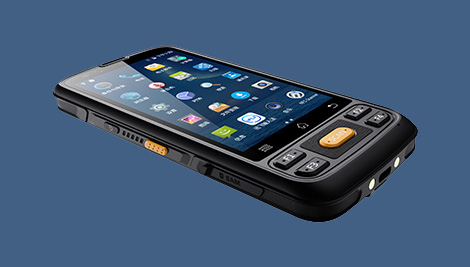
II. Key Functions of PDA Handheld Terminals
1.Efficient Data Collection
Multi-format Barcode Scanning: Supports 1D/2D/DM codes for instant traceability binding (e.g., raw material batches, QA reports).
RFID Tracking: Batch-identifies pallets and monitors real-time temperature/humidity for cold chain integrity.
Image Comparison: Detects label tampering via AI-powered camera.
2.Real-Time Data Transmission
Dual-mode 4G/5G/Wi-Fi ensures seamless cloud sync; offline caching prevents data loss.
3.Anti-Counterfeiting & Diversion Control
Dynamic encryption verifies code authenticity and geo-location (triggers alerts for unauthorized sales).
Serial number tracing enables reverse logistics for recalls.
4.Process Standardization
Role-specific workflows (e.g., production/QC staff) with e-signatures and permission controls.
5.Rugged Design
IP65-rated, 1.5m drop-proof, operable from -20°C to 50°C; 12-hour battery with fast charging.
III. Application Scenarios in Dairy Supply Chain
Farm Level: Drivers scan milk tank codes to record sources.
Production: Links equipment, operators, and QA data for electronic batch records.
Warehouse: Real-time inventory scans + FIFO management.
Distribution: Dealer location verification to block unauthorized sales.
Consumer Engagement: Provides lifecycle traceability via QR codes.
IV. Impact & Value
After PDA deployment, a dairy manufacturer achieved:
80% reduction in product diversion
90% faster traceability (problem identification from 72h → 2h)
40% lower labor costs with 99.9% inventory accuracy
V. Future Trends: From Tool to Platform
Edge Computing: On-device image recognition/data preprocessing.
Open APIs: Integration with MES/LIMS/TMS for unified digital management.
Low-Code Development: Customizable workflows via drag-and-drop tools.
Conclusion
PDA handheld terminals have evolved from "scanners" to intelligent hubs for dairy supply chains. By enabling precise traceability, real-time anti-diversion, and counterfeit prevention, PDAs empower manufacturers to build transparent, efficient operations — safeguarding consumer trust and competitive advantage. As IoT and big data advance, PDAs will become foundational to dairy digitalization.