

Amid rapid development in logistics and warehousing, enterprises demand higher operational efficiency, data accuracy, and management transparency. RFID (Radio Frequency Identification), a key IoT technology, is reshaping warehouse management through handheld terminals. This article focuses on the core functions of RFID handheld PDA devices in warehouse operations, analyzing how they serve as "intelligent extensions" for modern management across three dimensions: hardware performance, software adaptability, and scenario applications.
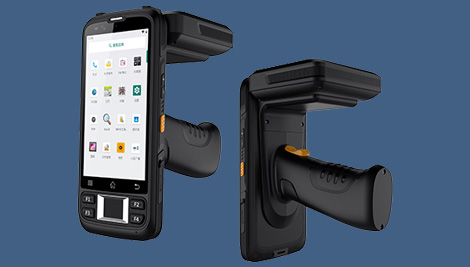
I. Data Capture & Real-Time Transmission: Building a Digital Warehouse Foundation
Multi-Tag Bulk Reading
RFID handheld PDAs excel in non-contact data collection. Equipped with HF or UHF modules, they can identify multiple tags simultaneously within a 15-meter range. During warehouse patrols, workers scan entire pallets instantly—eliminating barcode scanning—boosting efficiency by 5–10x. For example, outbound verification takes 5 minutes versus 30 minutes traditionally.
Environmental Resilience
Industrial-grade protection (IP65 rating, 1.5m drop resistance) ensures reliability in harsh conditions. Optimized antenna design and signal algorithms maintain >99.9% accuracy in metal-dense environments. Batteries operate stably at -20°C.
Real-Time Synchronization
Wi-Fi 6/4G/5G connectivity and edge computing enable instant data upload to WMS. Inventory heatmaps and task dashboards update within 3 seconds, supporting real-time decisions.
II. Precision Positioning & Route Optimization: Revolutionizing Patrols
Zone-Level Tracking
RFID base stations enable 1–3m accuracy for goods/personnel. Geo-fencing triggers alerts for high-value items and optimizes patrol paths, reducing travel distance by 30%.
Dynamic Inventory Engine
"Live inventory" mode compares real-time scans with system records, flagging discrepancies (e.g., quantity mismatches). One e-commerce warehouse cut annual stocktake from 72 to 8 hours with 99.9% accuracy.
Task-Driven Inspections
Integrated WMS auto-generates tasks based on turnover rates, expiry dates, or anomalies—shifting from "man-to-goods" to "goods-to-man" workflows.
III. Smart Assistance & Anomaly Handling: Closed-Loop Management
Visual Guidance
Industrial touchscreens display item images, specs, and history. Color-coded prompts and vibration alerts aid accuracy in mixed-SKU locations.
Anomaly Alerts
Multi-level warnings activate for:
Sudden tag signal loss (obstruction/damage)
Consecutive read failures
Deviations from preset routes
Alerts push to managers’ apps with troubleshooting guides for minute-level response.
Offline Cache & Recovery
Onboard storage caches 100k+ records. Data auto-syncs when networks recover, ensuring zero loss during events like Black Friday.
IV. Hardware Innovation & Scenario Adaptation
Modular Expansion
Interchangeable modules (barcode scanners, temperature sensors) adapt to specialized needs. In cold chains, sensors trigger inspections if temperatures fluctuate.
Ergonomic Design
Lightweight (400g), anti-slip grips, and glove-compatible screens ensure usability from -20°C to 60°C.
Extended Battery Life
Fast charging (30 mins = 5 hours of use) and hot-swappable batteries achieve 99% uptime per shift.
V. Future Value & Industry Applications
Evolving beyond scanners, RFID PDAs are becoming smart management terminals. Future integrations with digital twins and big data will enable:
Predictive maintenance via operational analytics
Optimized battery/energy management
Carbon footprint tracking across supply chains
As warehouses digitize, RFID handhelds bridge physical and digital worlds—creating efficient, transparent, and sustainable value chains.