

In today's rapid development of industrial automation and smart manufacturing, the efficiency and accuracy of data collection directly determine the optimization potential of production processes. As a key tool in the industrial identification field, handheld PDA scanning devices have become the core carrier for DPM code (Direct Part Marking) recognition due to their portability, high precision, and adaptability to multiple scenarios. This article will delve into the core functions of these devices in rapid DPM code recognition from dimensions such as hardware configuration, algorithm optimization, and scenario adaptation, providing reference for industry users in selection and application.
I. Technical Background and Device Positioning for DPM Code Recognition
DPM code is a type of QR code directly marked on product surfaces through methods like laser etching, dot peening, or inkjet printing. Due to its wear and corrosion resistance, it is widely used in high-precision manufacturing fields such as automotive parts, electronic components, and medical devices. Unlike traditional label-based QR codes, DPM code recognition imposes higher demands on the optical system and decoding algorithms of devices: it requires rapid decoding in complex environments like metal reflection, surface deformation, and low contrast.
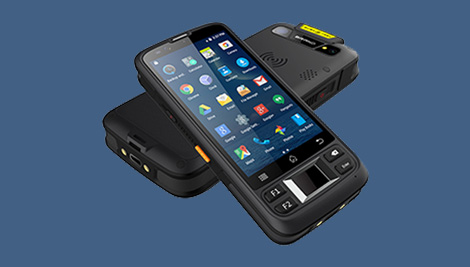
Handheld PDA scanning devices are designed to address DPM code recognition challenges by integrating professional-grade image capture modules and customized decoding algorithms. Their core value lies in: breaking environmental constraints, improving recognition efficiency, and ensuring data integrity, thereby helping enterprises achieve full-process traceability management.
II. In-Depth Analysis of Core Functional Modules
1.High-Precision Industrial-Grade Scanning Engine
Optical System Design: Utilizes customized liquid lenses or auto-focus modules, supporting a depth of field range from 0.15 to 1.5 meters to automatically adapt to DPM codes of different sizes. For example, for micro DPM codes on engine blocks, the device can achieve image capture with 0.1mm precision via macro mode.
Light Source Configuration: Equipped with multi-spectral LED lighting systems, including white, red, and infrared light bands, which can intelligently switch to handle scenarios like metal reflection, dark materials, or low light. Some models support ring lighting and polarized light technology to effectively suppress glare interference.
2.Dynamic Image Optimization Algorithms
Real-time Noise Reduction Processing: Uses hardware-level image signal processors (ISP) to perform dynamic range compression, edge enhancement, and noise filtering on raw images. Even with minor scratches or oil contamination on DPM codes, clear outlines can be extracted.
Distortion Correction Technology: For curved or angled scanning scenarios, built-in geometric correction algorithms automatically adjust image deformation to ensure decoding success. For instance, when recognizing cylindrical parts, the device can restore the code's original structure through 3D modeling.
3.Industrial-Grade Protection and Durability Design
Three-Proof Performance: IP65/IP67 dust and water resistance, withstands 1.5-meter drop impacts, and adapts to harsh environments like workshop oil and dust. Some models feature military-grade magnesium alloy casings with corrosion resistance up to 48 hours in salt spray tests.
Ergonomic Optimization: Designed with hand-holding curves, anti-slip textures, and detachable clips for single-handed operation over long periods. Touchscreens use Corning Gorilla Glass, supporting glove and wet-hand modes.
4.Efficient Data Interaction and Expansion Capabilities
Multi-Protocol Compatibility: Built-in 1D/2D code decoding engines support mainstream codes like DPM, Data Matrix, and QR Code, with expandable RFID reading and NFC functions for multimodal data collection.
Wireless Transmission: Supports Wi-Fi 6, Bluetooth 5.2, and 4G/5G networks for real-time data synchronization to MES, ERP, and other systems. Some models include USB 3.1 Type-C interfaces with speeds up to 5Gbps.
5.Intelligent Power Management System
Extended Battery Life: Uses polymer lithium-ion batteries with capacities above 5000mAh, enabling over 10 hours of continuous scanning. Supports fast charging, with 30 minutes of charging providing 4 hours of intensive use.
Low-Power Optimization: Dynamically adjusts CPU frequency and screen brightness, automatically entering power-saving mode during idle times to extend battery life.
III. Typical Application Scenarios and Value Demonstration
1.Automotive Production Lines: In engine assembly, handheld PDA devices rapidly identify DPM codes on parts like crankshafts and cylinder blocks, verifying material batches and process parameters in real-time, reducing assembly error rates below 0.01%.
2.Electronic Component Traceability: For small components in SMT workshops, the devices use macro scanning to recognize 0.5mm² DPM codes within 0.2 seconds, supporting over 30 scans per second for high-speed production lines.
3.Medical Device Management: In implantable medical device production, devices with sterile packaging can operate directly in clean rooms, enabling non-contact recognition of laser-engraved codes for full lifecycle traceability.
IV. Key Indicators for Device Selection
Decoding Speed: Prioritize models with hardware-accelerated decoding chips; DPM code recognition latency should be below 0.3 seconds.
Environmental Adaptability: Choose protection levels based on usage scenarios; for high-temperature environments, ensure an operating range of -20°C to 60°C.
System Compatibility: Confirm pre-installed Android or Windows systems and support for custom enterprise app development.
After-Sales Service: Opt for brands offering 3+ years warranty and 24/7 technical support to reduce maintenance costs.
Conclusion
As the terminal carrier for DPM code recognition, handheld PDA scanning devices demonstrate value not only in hardware breakthroughs but also in deep understanding of industrial pain points. Through synergistic innovation in optics, algorithms, and industrial design, these devices are reshaping data collection models in manufacturing, providing key support for building digital foundations. During selection, enterprises should combine their production line characteristics and long-term strategies to choose solutions with technical expertise and service guarantees, ensuring a competitive edge in the smart manufacturing wave.