

In today’s rapidly evolving logistics industry, the precision and intelligence of warehouse management directly determine operational efficiency. As critical hardware in logistics, RFID handheld terminals—equipped with contactless data capture and high-speed information processing—have become core tools for modern warehouses. This article explores RFID handheld terminals' key functions in warehouse management and how they solve industry pain points through technological optimization.
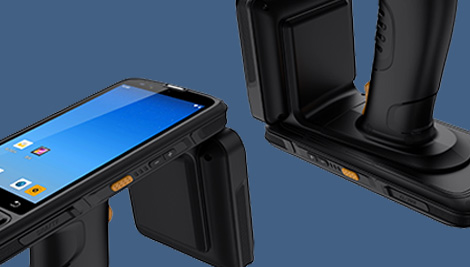
1. Dynamic Inventory Management: Real-time Data-driven Put-away Decisions
Traditional warehousing relies on manual records or barcode scanning, leading to data delays and misplacement. RFID handhelds enable instant tag reading via radio frequency, visualizing inventory status. Built-in HF/UHF modules penetrate packaging materials, batch-identifying tags within 0.5-25m ranges. Entire pallet verification completes in 3 seconds, even for densely stacked items.
Customizable slot-coding systems auto-validate cargo-storage compatibility. For example:
Temperature-sensitive goods trigger alerts for non-refrigerated zones
Irregularly shaped items receive optimized stacking suggestions
This reduces human error to <0.3% and increases slot utilization by 25-40%.
2. Intelligent Path Planning: Revolutionizing Relocation Efficiency
Traditional relocation faces three challenges: redundant paths, information silos, and manual errors. RFID terminals integrated with WMS enable smart task dispatching.
Features include:
Optimal path navigation avoiding congested zones via real-time heatmaps
Vibration/highlight alerts for target cargo detection
"Scan-Confirm-Execute" workflow for batch tasks
Auto-generated digital transfer records synced with inventory maps
3. Full-process Traceability: Visualized Operational Loop
RFID terminals record spatiotemporal data at each node, creating complete operation trails. Key capabilities:
Centimeter-level positioning via GPS/BeiDou dual-mode
Instant alerts triggered by unauthorized movement (geo-fencing)
Reverse traceability: Retrieve full history (operator, timestamp, location) with one cargo ID
This reduces cargo loss by 80% and dispute resolution time by 70%.
4. Multi-modal Data Integration: Breaking Information Silos
Modern warehouses require cross-system interoperability. RFID terminals offer:
API integration with ERP/TMS/MES systems
Bluetooth 5.0, Wi-Fi 6, and 4G/5G connectivity
Offline caching for 5,000+ operations (auto-sync when reconnected)
Customized coordination with AGVs/robotic forklifts for heavy-load relocation
5. Industrial-grade Durability: All-scenario Readiness
Built for harsh environments:
IP65 dust/water resistance
1.5m drop resistance
Operation range: -20°C to 60°C
Cold-chain features: Low-temp battery & anti-fog screen (-10°C/8hrs)
Ergonomic design:
<450g weight (GB/T 37668-2019 compliant)
Hot-swappable scanner modules (30-sec replacement)
6. Energy Efficiency: Balancing Performance & Longevity
Dual-battery hot-swap design:
12+ hours continuous operation per battery
Smart power management: Ultra-low power (standby) → High-performance (scanning)
40% overall energy efficiency improvement
Conclusion: Technology Empowering Logistics Transformation
RFID handheld terminals embody the fusion of data flow and physical logistics. By enabling real-time data capture, intelligent decision-making, and end-to-end traceability, they eliminate traditional efficiency bottlenecks and advance warehouses toward predictive management. For logistics enterprises pursuing lean operations, selecting customizable, industrial-grade RFID terminals is pivotal to building intelligent warehousing systems.