

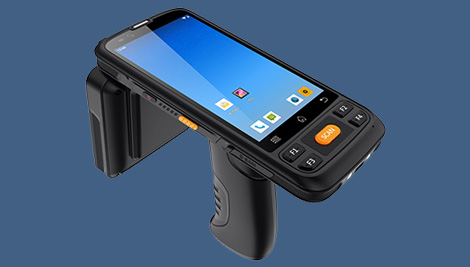
In the critical phase of transformation and upgrading in the textile industry, the efficiency of batch management for cloth directly impacts a company's production performance and cost control. Traditional management models, relying on manual recording and barcode scanning, struggle to meet the high-frequency, high-precision demands of modern textile enterprises. RFID (Radio Frequency Identification) handheld scanner devices, as key enablers of IoT technology, are reshaping cloth management operations in the textile sector with features like contactless data capture and batch rapid identification. This article focuses on the core functions of these devices in textile scenarios and explains how they enable digital upgrades in batch management through technological empowerment.
1. Contactless Data Capture: Solving Traditional Management Pain Points
Textile cloth comes in diverse roll forms and complex surface materials, making traditional barcode scanning reliant on manual label alignment and prone to failures due to wrinkles or stains. RFID handheld scanner PDA data collection terminals use radio frequency signals to penetrate cloth surfaces, enabling data reading without direct contact and effectively addressing the following issues:
Environmental Adaptability Breakthrough: The device operates stably in harsh workshop conditions like humidity and dust. For interference-prone materials like metallized synthetic cloth, optimized antenna design and signal frequency ensure an identification accuracy rate exceeding 99.9%.
Multi-Angle Rapid Identification: With circular polarization antenna technology, it supports 360-degree reading without blind spots. Operators don’t need to adjust angles; a single scan covers multiple tags within a 1-10 meter radius, improving efficiency by over 5 times compared to traditional methods.
Dynamic Tracking Capability: During cloth transfer, the device captures tag information in real-time while moving, suitable for dynamic scenarios like production line handling and vehicle loading/unloading, enabling "non-stop" data collection.
2. Batch Tag Synchronized Reading: Reconstructing Warehouse Operations
A single cloth roll typically requires recording over 10 parameters, such as batch number, weight, color code, and warp-weft density. Traditional single-scan models cause congestion in inbound/outbound processes. The core advantages of RFID handheld scanner PDAs include:
Group Reading Technology Breakthrough: Optimized anti-collision algorithms allow simultaneous identification of 50-200 electronic tags. In densely stacked scenarios, full pallet cloth information verification completes in 30 seconds, boosting efficiency by 80% compared to manual inventory.
Intelligent Filtering Function: Supports setting filters by production date or customer orders, quickly locating target batches in mixed storage environments and reducing manual search time by over 60%.
Data Validation Mechanism: Built-in validation algorithms automatically compare physical items with system data, providing real-time alerts for misplaced or unscanned items, keeping warehouse error rates below 0.05%.
3. End-to-End Data Integration: Building a Visual Traceability System
Textile enterprises often involve multiple processes like spinning, weaving, dyeing, and finishing. RFID handheld devices integrate deeply with MES and ERP systems to create a complete batch lifecycle record:
Raw Material Inbound Management: Scanning raw material roll tags automatically links supplier information and quality reports, establishing a batch gene database for quality traceability.
Production Process Binding: At key nodes like weaving or dyeing, device scans update process parameters instantly, forming a "one-code-through" production history for rapid deviation tracing.
Finished Product Outbound Verification: Connects with intelligent sorting systems to auto-verify cloth specifications and lengths against orders, eliminating traditional issues like shipping errors or omissions.
4. Mobile Operation Support: Extending Management Reach
RFID handheld scanner PDAs break fixed workstation limits with mobile functions:
PDA Integrated Design: Combines scanners with industrial PDAs, allowing operators to record defects or modify parameters on-site, with data syncing to the cloud in real-time, reducing paper-based workflows.
Offline Cache Mechanism: Stores over 10,000 scan records offline, automatically resuming uploads when the network recovers to ensure data integrity.
Voice Interaction: Supports voice commands and data announcements in noisy environments, lowering operational barriers and enhancing safety.
5. Energy Efficiency and Durability Optimization: Adapting to Industrial Settings
Textile workshops operate 24/7, demanding high device stability:
Extended Battery Life: Uses low-power chips and smart power management for over 8 hours of continuous scanning on a full charge, with hot-swappable batteries for uninterrupted use.
Industrial-Grade Protection: IP65-certified for dust and water resistance, withstands 1.5-meter drops, and operates in temperatures from -20°C to 60°C, remaining stable in lint-filled environments.
Modular Expansion: Features USB, Bluetooth, and 4G/5G interfaces for adding modules like fingerprint scanners or cameras to meet custom needs.
6. Deep Data Value Mining: From Collection to Decision-Making
RFID handheld scanner PDAs are not just data terminals but gateways to digital transformation:
Real-Time Inventory Dashboard: Scans generate dynamic heatmaps for inventory, aiding safety stock strategies and reducing capital tie-up.
Production Alert System: Sends warnings to management if a batch lingers too long, preventing work-in-progress pile-ups.
Quality Traceability Loop: Establishes bidirectional traceability from raw materials to finished goods, enabling full-process root cause analysis within 2 hours for quality issues.
Conclusion
In the wave of smart manufacturing transformation for the textile industry, RFID handheld scanner PDA data collection terminals have evolved beyond simple data tools to become neural endpoints connecting the physical and digital worlds. By continuously improving identification accuracy, expanding application scenarios, and deepening data value, this technology is driving cloth management from "experience-driven" to "data-driven." For textile firms pursuing lean production, choosing equipment suppliers with proprietary algorithm R&D and deep vertical expertise is key to building intelligent batch management systems.