

In laboratory management scenarios, the efficiency of data collection and asset inventory directly impacts research progress and resource utilization. Traditional manual recording methods suffer from issues such as data lag, errors, and difficulty in traceability. Industrial-grade PDA handheld data collectors, with their professional design, have become a key tool to address these pain points. This article focuses on their core functions, analyzing how technology empowers improvements in laboratory management efficiency.
I. Accurate Data Collection: Building the Foundation for Lab Data
1.1 Multi-dimensional Barcode Recognition Capability
Industrial-grade PDAs are equipped with high-precision scanning engines, supporting rapid recognition of 1D barcodes, 2D barcodes, and DPM (Direct Part Marking) codes. For example, in chemical reagent management, scanning QR codes on reagent bottles automatically links key information such as reagent name, concentration, and production date, avoiding confusion from manual entry or misjudgment of expiration dates. After implementation in a biological laboratory, reagent mismatch rates decreased by 90%, and inventory data accuracy increased to 99.9%.
1.2 Real-time Data Validation Mechanism
The devices feature built-in intelligent validation algorithms that instantly compare collected data with backend databases. For instance, in equipment maintenance scenarios, when technicians scan instrument QR codes, the industrial-grade PDA data collectors automatically verify the latest maintenance records and trigger alerts if inspections are overdue. This closed-loop verification ensures laboratory operations comply with quality management standards like ISO 17025.
II. Full-scenario Adaptability: Breaking Laboratory Environmental Constraints
2.1 Industrial-grade Protective Design
Designed for common laboratory environments such as high humidity and dust, the devices meet IP67 protection standards, withstanding drops of 1.5 meters and brief immersion in water. Data from a pharmaceutical company laboratory showed that in environments with humidity up to 75%, the equipment operated continuously for 48 hours without failure, with scanning sensitivity unaffected.
2.2 Ergonomic Operation Experience
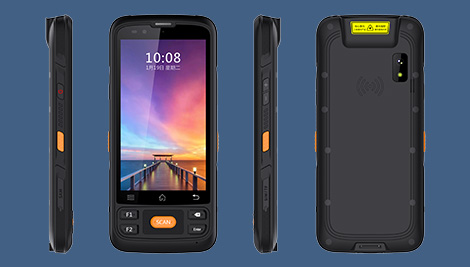
A 5.5-inch HD touchscreen combined with physical buttons meets the needs of gloved operation. In scenarios requiring frequent scanning, workers can quickly switch function modules via customizable shortcut keys, enabling single-handed data entry and confirmation.
III. Intelligent Collaboration: Integrating Laboratory Management Chains
3.1 Real-time Data Synchronization System
Industrial-grade PDA data collectors support Wi-Fi 6 and 5G dual-mode communication, allowing collected data to sync within seconds to Laboratory Information Management Systems (LIMS). In practice at a materials research institute, the time from data collection to report generation was reduced from 2 hours to 15 minutes, significantly accelerating research workflows.
3.2 Seamless Integration with Multiple Systems
The devices support deep integration with systems like ERP and MES. For example, during equipment inventory, scanning fixed asset tags with a PDA automatically updates asset ledgers in financial systems and syncs with access control systems for dynamic permission adjustments. This cross-system linkage increased laboratory resource allocation efficiency by 40%.
IV. Security Control: Safeguarding Research Data Assets
4.1 Three-tier Permission Management System
Industrial-grade PDA handheld devices feature built-in NFC near-field communication modules combined with biometric technology, enabling hierarchical control of operation permissions. Ordinary lab technicians can only query basic data, while project leaders access complete experimental records, ensuring sensitive data remains confidential.
4.2 Data Encryption Transmission Protocol
Using AES-256-bit encryption, all collected data undergoes dual encryption before transmission. Tests at a national laboratory showed that even on public Wi-Fi, data interception and decryption success rates were below 0.01%.
V. Analysis of Typical Application Scenarios
5.1 Full Lifecycle Management of Reagents and Consumables
Every stage from warehousing to consumption is recorded via PDA:
Inbound Inspection: Scanning supplier barcodes automatically verifies batch inspection reports.
Outbound Issuance: Scanning links to experimental projects and deducts inventory in real time.
Low-stock Alerts: Automatically pushes purchase requests when reagent levels fall below safety thresholds.
5.2 Collaborative Calibration of Precision Instruments
In large-scale instrument cluster management, PDAs can:
Record equipment usage logs, including operators and runtime.
Scan calibration certificate QR codes to auto-generate calibration schedules.
Connect to temperature and humidity sensors for real-time monitoring of storage environments.
VI. Key Selection and Implementation Considerations
6.1 Hardware Configuration Recommendations
Protection Level: Prioritize devices with IP65 or higher for complex lab environments.
Scanning Performance: QR code recognition speed should be ≥300 scans/minute, with DPM code recognition distance ≥10cm.
Battery Life: Continuous operation should exceed 12 hours, with support for fast-charging technology.
6.2 Software System Adaptation
Provide open API interfaces for easy integration with existing LIMS systems.
Support customized form design to meet unique experimental data collection needs.
Include offline caching to prevent data loss during network outages.
Conclusion
Industrial-grade PDA handheld data collectors are reshaping laboratory management models through three core capabilities: precise collection, real-time collaboration, and security control. Their value extends beyond efficiency gains to creating a traceable, analyzable, and optimizable digital management loop. With the evolution of IoT technology, PDAs will integrate deeper with smart sensors and AI algorithms, bringing more innovation to lab management. Choosing suitable industrial-grade PDA solutions has become an essential step for research institutions to enhance competitiveness.