

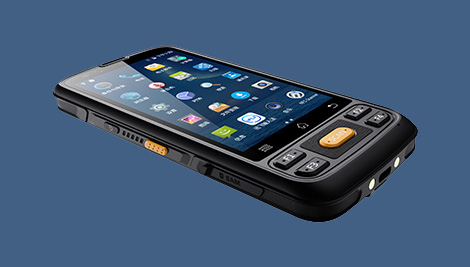
Driven by both consumption upgrades and the wave of digitalization, transparent management of the fresh supply chain has become key to breaking industry deadlocks. From farm to table, every step fresh products take—harvesting, sorting, warehousing, transportation, sales—contains information gaps that can exacerbate loss, escalate costs, and even pose food safety risks. As intelligent terminals in the IoT era, Barcode Data Collector PDAs (Personal Digital Assistants) are building a "transparency" bridge for the fresh supply chain with their core capabilities of real-time data collection, end-to-end traceability, and intelligent decision support.
I. The Dilemma of Fresh Supply Chain Transparency: The Urgent Need from "Blind Spots" to "Visibility"
The unique nature of fresh products determines the complexity of their supply chain:
Perishability Challenge: Fresh products have short shelf lives. Fluctuations in temperature and humidity directly impact quality, yet environmental monitoring data in traditional supply chains often relies on manual logs, risking delays and inaccuracies.
Information Silos: Data is scattered among multiple entities—growers, logistics providers, warehouses, retailers—lacking unified standards and sharing mechanisms.
Loss Black Holes: Statistics show the circulation loss rate for fresh products in China is as high as 20%-30%, far exceeding the 5% level in developed countries. Overage inventory and transportation delays caused by opaque information are significant contributors.
Consumer Trust Crisis: Against a backdrop of frequent food safety incidents, consumer demand for product traceability is intensifying. However, traditional methods like paper receipts and manual ledgers are inefficient and easily tampered with.
The intervention of Barcode Data Collector PDAs aims to break down these barriers. By connecting the physical and digital worlds, they enable real-time collection, upload, and analysis of data across all supply chain stages, turning "invisible loss" into "quantifiable optimization potential."
II. How PDAs Build Fresh Supply Chain Transparency? An Analysis of Four Core Capabilities
1. Real-Time Data Collection: From "Post-Facto Recording" to "In-Process Control"
Traditional supply chains rely on manual scanners or data entry, which is inefficient and error-prone. PDAs, integrated with multi-modal perception modules like high-definition cameras, RFID readers, and temperature/humidity sensors, enable:
Multi-Scenario Adaptation: In cold storage environments, PDAs with industrial-grade protection can withstand temperatures as low as -20°C, ensuring uninterrupted data collection. In transport vehicles, they connect via Bluetooth to onboard temperature/humidity loggers for real-time environmental monitoring.
Dynamic Data Capture: For example, during sorting, scanning barcodes on fruit/vegetable packaging simultaneously records weight, grade, origin, and automatically matches this with order systems, avoiding manual verification errors.
Exception Alert Mechanisms: When a product batch's temperature exceeds limits, the PDA can immediately trigger an alarm and push data to the management platform via 4G/5G, enabling rapid response.
2. End-to-End Traceability: From "Fragmented" to "Seamless"
Using unique identification codes (e.g., GS1 standards), PDAs link data from all supply chain segments, forming a complete "digital twin" chain:
Production End: Farmers use PDAs to scan electronic product labels, uploading harvest times, pesticide use records, etc.
Logistics End: Drivers use PDAs to record loading times, transport routes, and container temperature curves, creating "digital waybills."
Warehouse End: PDAs interact with Warehouse Management Systems (WMS), updating inventory locations and providing shelf-life alerts in real-time to prevent accumulation of near-expiry products.
Retail End: Consumers scanning product QR codes can view the entire journey from farm to store, boosting purchase confidence.
3. Intelligent Decision Support: From "Experience-Driven" to "Data-Driven"
The massive data collected by PDAs, processed via cloud computing and analytics, transforms into actionable insights for supply chain optimization:
Demand Forecasting: By comparing historical sales data with real-time inventory, PDAs can generate dynamic replenishment suggestions, reducing stockouts or surplus risks.
Route Optimization: Integrating traffic data and order distribution, PDAs can plan optimal delivery routes, lowering transport costs and time loss.
Quality Analysis: Tracing batches with high loss rates helps pinpoint problematic links (e.g., broken cold chain, rough handling), driving process improvements.
4. Collaborative Efficiency: From "Linear Cooperation" to "Network Collaboration"
As mobile terminals, PDAs break down information barriers between supply chain entities:
Farmer-Buyer Collaboration: Farmers receive purchase orders via PDA, harvest accordingly, and upload data, reducing invalid production.
Logistics-Warehouse Collaboration: PDAs synchronize in-transit goods information in real-time, allowing warehouses to prepare unloading bays and storage areas in advance, shortening handover times.
Brand-Consumer Collaboration: Companies use consumer feedback data collected via PDAs to inversely optimize product varieties and supply chain strategies.
III. PDA Application Scenarios: Typical Cases of Enhanced Fresh Supply Chain Transparency
Scenario 1: The "Temperature Steward" for Cold Chain Logistics
A fresh e-commerce enterprise deployed PDAs in its refrigerated trucks, collecting cabin temperature data every 5 minutes and comparing it against preset thresholds. If temperatures deviated, the PDA immediately sent alerts via app to both the driver and dispatch center, while recording the anomaly's duration and location. Post-implementation, the company's cold chain loss rate dropped from 8% to 0.01%, and customer complaints decreased by 60%.
Scenario 2: The "Efficiency Innovator" in Wholesale Markets
Traditional wholesale markets relied on manual invoicing, which was inefficient and error-prone. After introducing PDAs, merchants scan buyer membership codes and product barcodes to automatically generate electronic slips synced with financial systems. Average transaction time shortened from 5 minutes to 30 seconds, and account reconciliation accuracy rose to 99.9%.
Scenario 3: The "Dynamic Replenishment" in Retail Stores
A chain supermarket uses PDAs to scan shelf barcodes, obtaining real-time inventory data and sales trends. When a product's stock falls below the safety threshold, the system automatically generates a replenishment order and pushes it to the nearest warehouse, ensuring shelf availability stays above 95%.
IV. Future Outlook: The Deep Integration of PDAs and Supply Chain Digitalization
With the maturation of 5G, AI, and Blockchain technologies, PDA applications in the fresh supply chain will trend towards:
Edge Computing Empowerment: Enhanced local data processing on PDAs reduces cloud dependency and improves real-time response.
AI Visual Recognition: Cameras automatically identify product type and freshness, minimizing manual scanning.
Blockchain Traceability: Data collected by PDAs is directly recorded on the blockchain, ensuring tamper-proof traceability and bolstering consumer trust.
Low-Carbon Supply Chain: Integrated with carbon emission calculation models, PDAs can optimize transport routes and packaging solutions, aiding carbon neutrality goals.
Conclusion
The innovation in fresh supply chain transparency is, at its core, a data-driven reconstruction of efficiency and trust. As the "nerve endings" of this innovation, Barcode Data Collector PDAs, with their real-time, precise, and collaborative nature, are turning the supply chain from a "black box" into a "clear mirror." For enterprises, PDAs represent not just a tool upgrade, but a starting point for business model innovation. Through data transparency, companies can build differentiated competitive advantages and navigate the dual challenges of quality competition and cost control. In the future, with continuous technological iteration, PDAs may very well lead the fresh supply chain into a completely new era of "what you see is what you get."