

In the wave of medical informatization, mobile nursing devices have become key tools for enhancing healthcare service quality. As industrial-grade terminals specifically designed for medical scenarios, the mobile nursing PDA handheld industrial terminal is playing an irreplaceable role in admission management, patient care, medication verification, and other aspects, thanks to its portability, durability, and professional functions. This article will focus on its practical applications in admission management, analyzing how it builds an efficient and secure management closed-loop for medical institutions through hardware optimization and functional innovation.
I. Industrial-Grade Design: Hard Power Adapting to Complex Medical Scenarios
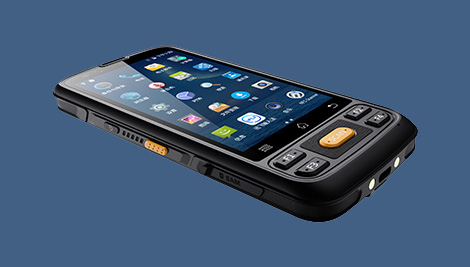
The reliability requirements for equipment in medical environments far exceed those of ordinary consumer-grade products. The mobile nursing PDA adopts military-grade protection standards, with the device body certified IP65 for dust and water resistance, and can withstand impacts from drops of up to 1.5 meters in height. Even in high-risk environments such as inpatient departments with frequent disinfection sprays and equipment collisions, it maintains stable operation. Its 5.5-inch high-definition touchscreen supports glove touch and wet-hand operation, allowing nurses to perform system tasks smoothly while wearing sterile gloves or with damp hands.
The ergonomic design of the device fully considers clinical usage scenarios: the anti-slip texture on the back ensures stability during one-handed holding, and dedicated physical buttons enable quick activation of core functions (such as scanning and calling), avoiding delays from multi-layer menu operations. The dual-mode wireless communication module (Wi-Fi 6 + 4G/5G) guarantees real-time data transmission, maintaining network stability even in densely populated ward areas, and preventing data delays or losses due to signal interruptions.
II. Digital Transformation of the Entire Admission Management Process
The admission process involves multiple operations such as patient information verification, medical record creation, order reception, and prepayment. Traditional manual methods suffer from inefficiency, high error rates, and information silos. The mobile nursing PDA handheld industrial terminal achieves process reengineering through three core functions:
Patient Identity Verification System
Integrated with a high-definition camera and NFC read-write module, it supports multi-dimensional identity recognition via ID cards, health insurance cards, wristband QR codes, and more. After scanning patient documents, the system automatically compares data with the HIS (Hospital Information System), completing identity verification within 3 seconds to effectively prevent impersonation risks. For unconscious patients or infants, the device supports association and binding with family member information to ensure a complete identity chain.
Instant Electronic Medical Record Entry
Through customized nursing software, nurses can complete admission assessment forms at the bedside. The built-in voice-to-text function supports dialect recognition, converting oral statements into structured data automatically to reduce text input. The vital sign data collection module can connect to Bluetooth devices such as blood pressure monitors and glucose meters, with measurement results synchronized directly to electronic medical records to avoid manual transcription errors.
Closed-Loop Order Management System
Seamlessly integrated with physician workstations, it receives electronic orders in real-time. Nurses scan patient wristbands and medication packaging QR codes, and the system automatically verifies the "five rights" principle (right patient, drug, dose, time, and route), issuing immediate alerts for anomalies. Every operation recorded by the device includes a timestamp and operator signature, forming tamper-proof electronic traces that meet the requirements of the three-level ward round system.
III. Multi-Scenario Application Extension: From Admission to Full-Cycle Care
The value of the mobile nursing PDA handheld industrial terminal extends beyond the admission phase, covering the entire patient hospitalization cycle:
Medication Management: By scanning electronic supervision codes on medications, it enables traceability from the pharmacy to the ward. The high-value medication dual-signature verification function requires two nurses with different permission levels to operate simultaneously, mitigating medication risks.
Closed-Loop Specimen Testing: Scanning tube QR codes binds them to patient wristbands, with the system automatically optimizing delivery paths to laboratories. If delays occur, automatic reminders are triggered to shorten TAT (turnaround time).
Nursing Quality Control: The built-in SOP (Standard Operating Procedure) library provides over 200 nursing operation guidelines. Nurses must scan to confirm steps during special procedures, allowing quality control offices to review operation videos in real-time.
IV. Data Security and Privacy Protection System
Medical data breaches can lead to severe legal risks, so the device employs multiple protection mechanisms:
Hardware-Level Encryption: Equipped with a national cryptographic SM4 algorithm chip, all stored data is automatically encrypted, remaining secure even if the device is lost.
Role-Based Access Control: Permissions are assigned by role—nurses access only their assigned patient data, department heads view full-department metrics, and hospital directors can retrieve operational reports for the entire facility.
Audit Trail Function: Logs over 40 types of operations, including device logins, data modifications, and system setting changes, supporting multi-dimensional searches by time, operator, and operation type.
V. Industry Challenges and Solutions
Despite the significant value demonstrated by mobile nursing PDAs, medical institutions still face three major challenges during deployment:
Network Coverage Blind Spots: Deploying dedicated medical IoT (IoMT) ensures full signal coverage in wards, corridors, elevators, and other areas, keeping devices always online.
Terminal Battery Life Anxiety: Utilizing low-power chip sets and intelligent power management systems, the device operates for up to 12 hours continuously in high-frequency usage scenarios. Fast-charging technology allows 30 minutes of charging for 4 hours of use.
System Compatibility Issues: Device manufacturers provide standardized API interfaces to connect with heterogeneous systems like HIS, LIS, and PACS, along with support for custom development to meet specialized department needs.
The proliferation of the mobile nursing PDA handheld industrial terminal marks a shift in nursing work from "experience-driven" to "data-driven." Through triple guarantees of hardware reliability, functional professionalism, and data security, it not only optimizes foundational processes like admission management but also creates compound value in enhancing medical quality, controlling operational costs, and improving patient experience. As technology iterates and applications deepen, this "mobile nursing workstation" will unlock greater potential, becoming essential infrastructure for smart hospital construction.