

In the clothing wholesale industry, inventory management has always been a key factor determining operational efficiency and cost control. Traditional manual counting methods are not only time-consuming and labor-intensive but also prone to human errors leading to data distortion, which affects procurement decisions and capital turnover. With the maturity of IoT technology, PDA handheld systems specifically designed for the clothing industry have become a powerful tool to solve inventory management challenges. This article will start from practical application scenarios, deeply analyze the core functional modules of the system, and demonstrate how it reshapes the supply chain ecosystem of wholesale enterprises through digital means.
I. Full-process Data Collection and Intelligent Management
Multi-dimensional Product Information Entry
The system supports rapid entry of key attributes such as clothing categories, sizes, colors, and batches through PDA devices, with options to add extended information like fabric composition and washing instructions. Operators simply scan product barcodes to automatically associate preset parameter templates, avoiding manual input errors. For items without barcodes, the system provides batch barcode generation to ensure each product has a unique digital identity.
Dynamic Inventory Tracking System
Using RFID radio frequency identification technology, the system enables rapid batch identification of goods. After deploying fixed readers in warehouse aisles, the system automatically registers entire batches of goods during entry or exit when pallets carrying clothing pass by, with an error rate below 0.01%. For scattered items, the PDA device supports single-item scanning to update inventory location and status in real-time.
Intelligent Location Management System
The system features a built-in 3D location mapping function, allowing users to locate stored goods by scanning shelf tags with a PDA. When location adjustments occur, the system automatically generates movement records to ensure real-time synchronization between WMS (Warehouse Management System) data and physical positions. For common scenarios like mixed color and size storage in clothing wholesale, the system supports virtual partitioning by SKU (Stock Keeping Unit), improving picking efficiency by over 30%.
II. Real-time Collaboration and Data Integration Mechanism
Offline and In-transit Operation Mode
For warehouse environments with unstable network signals, the system offers a dual-mode architecture with local caching and cloud synchronization. Operators can complete counting tasks offline, with the device storing operation logs and automatically uploading data once the network recovers. This mode ensures continuity in large-scale warehouse counts, preventing data loss due to network interruptions.
Multi-terminal Data Synchronization
The system supports data interoperability across PDA, PC, and mobile apps. After on-site counting by warehouse staff using PDAs, data is pushed in real-time to management PCs for generating visual dashboards. Store assistants can query real-time total warehouse inventory via apps for precise transfers. Data updates across all links have a delay of under 3 seconds, building a complete supply chain information chain.
Abnormal Data Warning Mechanism
With over 20 built-in risk control rules, the system immediately issues warnings via PDA vibrations and backend notifications when detecting anomalies like negative inventory, long-term unsold items, or misplaced goods. Managers can set hierarchical thresholds, such as automatically triggering promotion suggestions for items unsold for over 90 days, effectively reducing inventory turnover days.
III. Precise Decision Support System
Intelligent Replenishment Model
Based on historical sales data, seasonal indices, promotions, and other multi-dimensional parameters, the system builds a big data-driven forecasting model to generate dynamic replenishment suggestions. For common issues like out-of-stock popular sizes in clothing wholesale, the system automatically calculates safety stock thresholds and generates purchase orders sent to supplier systems when actual inventory falls below the alert line.
Multi-dimensional Analysis Reports
The system provides over 30 standardized reports, including SKU sales analysis, inventory age structure, and warehousing cost analysis, supporting free combinations by brand, category, season, and other dimensions. Managers can access data anytime via PDA, such as quickly viewing inventory turnover rates for specific categories during warehouse inspections, aiding on-site decision-making.
Supply Chain Collaboration Platform
The system integrates upstream and downstream ERP systems, enabling three-tier data flow between suppliers, wholesalers, and retailers. When wholesaler inventory drops below safe levels, the system automatically sends replenishment requests to core suppliers and syncs production schedules. For franchise stores, it supports setting up virtual inventory pools for real-time inter-store transfer settlements.
IV. Industrial-grade Equipment Guarantee System
Military-grade Protection Design
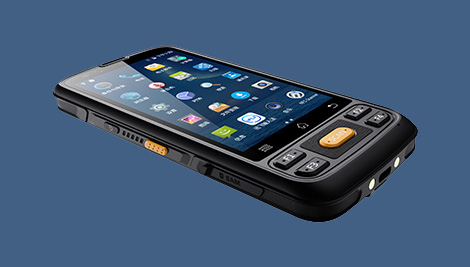
PDA devices are IP67 certified for dust and water resistance, withstand 1.5-meter drop impacts, and operate in extreme temperatures from -20°C to 60°C. For dusty clothing warehouse environments, the devices feature sealed button designs to ensure long-term stable performance.
Extended Battery Life Solution
Equipped with 5000mAh removable batteries and hot-swap technology, the devices support 7×24 continuous operation. An intelligent power management system adjusts energy consumption based on usage intensity, providing over 12 hours of runtime in continuous scanning mode.
Custom Development Interfaces
The system offers open API interfaces for seamless integration with existing WMS, TMS, and financial systems. For unique clothing industry needs, it can develop custom modules like quality inspection management, tag printing, and box grouping to build personalized solutions.
V. Value Reconstruction in Application
After implementing this system, a medium-sized clothing wholesaler achieved the following improvements:
Counting efficiency increased by 400%, with full-cycle counts in a 10,000-person warehouse reduced from 7 days to 1.5 days
Inventory accuracy rose from 82% to 99.9%, reducing annual losses by over 2 million yuan
Warehousing labor costs decreased by 35%, freeing up resources for value-added services
Supply chain response speed improved by 50%, with order fulfillment timeliness reaching 99%
In the wave of digital transformation, clothing wholesale enterprises are shifting from "experience-driven" to "data-driven" operations. The PDA handheld system not only addresses traditional inventory management pain points but also builds a real-time, transparent, and intelligent supply chain system to create core competitive advantages. With the deep integration of 5G and IoT technologies, future inventory systems will evolve toward predictive maintenance and intelligent scheduling, continuously generating incremental value for the industry.